
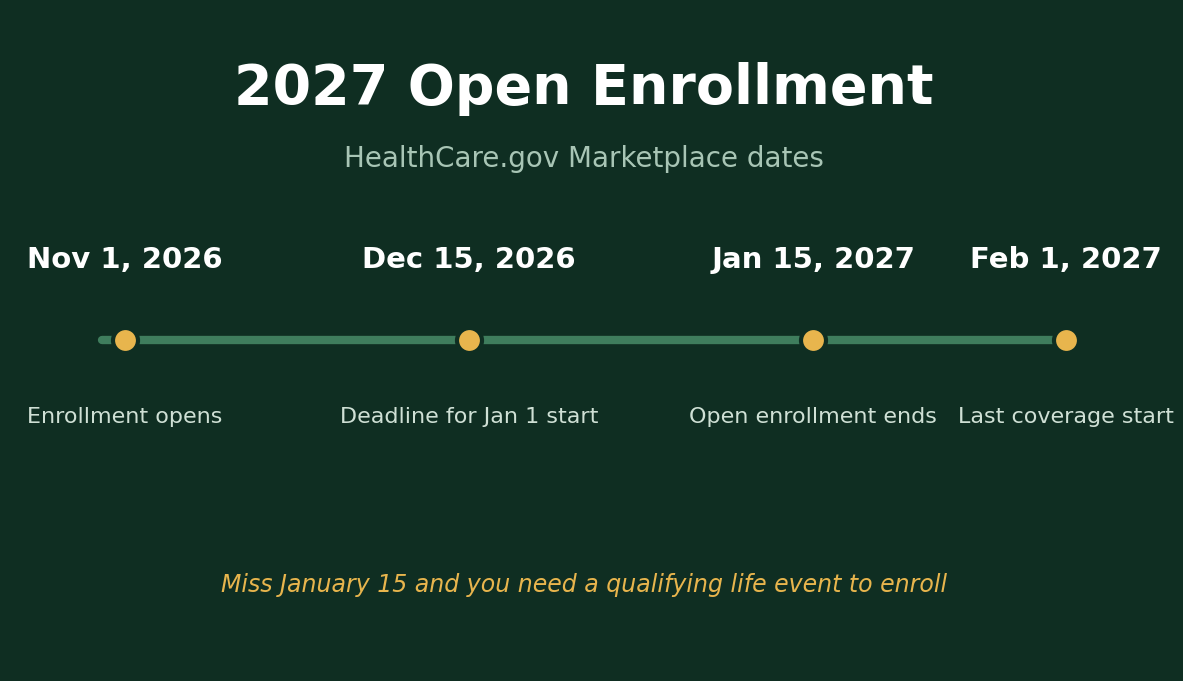
Open enrollment is the one window each year when most self-employed people in the U.S. can pick or change an individual health plan without needing a qualifying life event. For 2027 coverage, the federal Marketplace window runs November 1, 2026 through January 15, 2027. This guide covers the dates, what changed with subsidies, how premium tax credits work with freelance income, and how the self-employed health insurance deduction fits in.
2027 open enrollment dates
HealthCare.gov lists these dates for 2027 coverage:
| Date | What happens |
|---|---|
| November 1, 2026 | Open enrollment starts. First day to enroll in, renew, or change Marketplace plans for 2027. |
| December 15, 2026 | Last day to enroll or change plans for coverage that starts January 1, 2027. |
| January 1, 2027 | Coverage starts for anyone who enrolled by December 15 and paid the first premium. |
| January 15, 2027 | Open enrollment ends. After this, enrolling or changing plans requires a Special Enrollment Period. |
| February 1, 2027 | Coverage starts for enrollments between December 16 and January 15. |
States that run their own marketplaces can set different windows, and some offer extra state-funded help. Oregon, for example, moves enrollees to its own ExploreHealthOR.gov site for 2027 coverage. Check the marketplace for your state before assuming the federal dates apply.
What changed with subsidies for 2027
The enhanced premium tax credits that applied from 2021 through 2025 expired at the end of 2025. For 2027 coverage, the premium tax credit is again limited to household incomes between 100% and 400% of the federal poverty level, using the 2026 poverty guidelines. For a single person in the 48 contiguous states and D.C., that band is roughly $15,960 to $63,840. Above 400% of the poverty level, no credit is available at all, so coverage costs the full sticker price.
A second change matters for anyone with variable income. Beginning with the 2026 tax year, the caps that used to limit how much excess advance premium tax credit you had to repay at filing were removed. If you take more credit during the year than your final income supports, the full difference is settled on your tax return. Freelancers whose income swings month to month should update their Marketplace income estimate whenever it changes materially.
Analysts at KFF report that premiums rose sharply going into 2026 and again for 2027, and that some state exchanges, including California and New Mexico, are using state funds to offset part of the lost federal help. The practical takeaway: prices and assistance differ more by state and income this year than they did under the enhanced credits, so run your own numbers rather than relying on last year’s premium.
How premium tax credits work with freelance income
The credit is based on the household income you estimate for the coverage year. You can take all, some, or none of it in advance to lower each monthly premium, and the Marketplace settles the final amount on your tax return. Two rules are worth keeping in view:
- Only Marketplace plans qualify. Buying the same plan directly from an insurer means no credit.
- Estimates can be updated. If a slow quarter or a big contract moves your expected income, update the application so the advance credit tracks reality.
If you left a job this year and lost its coverage, that loss is a qualifying life event, so you do not have to wait for open enrollment to buy a Marketplace plan. The same applies to other events like moving or a new dependent.
The self-employed health insurance deduction
Separate from the credit, most freelancers can deduct health insurance premiums through the self-employed health insurance deduction. It is an adjustment to income figured on Form 7206 and reported on Schedule 1 of Form 1040, so it lowers income tax whether or not you itemize. It does not reduce self-employment tax.
The main conditions, from the IRS instructions for Form 7206:
- You need net profit from self-employment, reported on Schedule C or Schedule F (partners and more-than-2% S corporation shareholders have parallel rules).
- The policy can cover medical, dental, vision and qualified long-term care insurance for you, your spouse, your dependents, and children under 27, even if a child is not your dependent.
- No deduction for any month you were eligible to join an employer-subsidized plan, whether through your own employer, your spouse’s employer, or the employer of your dependent or a child under 27. Eligibility alone blocks the month even if you never enrolled.
- The deduction cannot exceed your earned income from the business the plan is tied to.
- Sole proprietors can hold the policy in their own name; it still counts as established under the business.
When both the premium tax credit and this deduction apply to the same year, the same premium dollars cannot count twice. IRS Publication 974 describes the iterative calculation that splits premiums between the two benefits; tax software generally handles it.
Choosing a plan as a freelancer
A few practical notes while comparing 2027 plans:
- Price with your real income estimate. The credit can be large under 400% of the poverty level and zero above it, so the same plan can cost very different amounts at different incomes.
- Consider HSA-eligible plans. A qualifying high-deductible plan opens an HSA, one of the few remaining triple-tax-advantaged accounts; our HSA rules guide for freelancers covers 2026 eligibility and limits.
- Budget for the deductible, not just the premium. A premium is fixed, but the deductible is a variable expense; a separate reserve helps, similar to setting aside money for taxes.
- Re-shop every year. Premiums and insurer participation change annually, and this year they changed more than usual.
Premiums you pay also belong in your broader deduction picture; the 1099 deductions cheat sheet shows how the health insurance deduction sits alongside retirement contributions and the QBI deduction.
If you miss the January 15 deadline
After open enrollment closes, individual Marketplace coverage is only available through a Special Enrollment Period triggered by a qualifying life event: losing other health coverage, moving, getting married, or gaining a dependent, among others. Medicaid and CHIP accept applications year-round for those whose income qualifies, which can matter in a slow freelance year.
Whatever you choose, enrollment decisions pair naturally with the rest of your year-end money review; our estimated tax guide covers the payment side of the same income estimate you give the Marketplace.
Frequently asked questions
When is open enrollment for 2027 health coverage?
On the federal Marketplace, November 1, 2026 through January 15, 2027. Enroll by December 15, 2026 for coverage starting January 1, 2027. States with their own marketplaces may run different dates.
Can a freelancer still get a premium tax credit in 2027?
Yes, if estimated household income is between 100% and 400% of the federal poverty level under the 2026 guidelines, and only through a Marketplace plan. The enhanced credits that removed the 400% cap expired at the end of 2025.
What if my freelance income ends up higher than I estimated?
Beginning with the 2026 tax year there is no cap on repaying excess advance premium tax credits, so the full difference is settled on the tax return. Updating the income estimate during the year reduces that risk.
Can I deduct my health insurance premiums as a freelancer?
Generally yes, through the self-employed health insurance deduction figured on Form 7206 and reported on Schedule 1 of Form 1040. It requires net self-employment profit, is blocked for any month you could have joined an employer subsidized plan, and does not reduce self-employment tax.
Can I use both the premium tax credit and the self-employed deduction?
Yes, but the same premium dollars cannot count twice. When both apply, IRS Publication 974 describes an iterative calculation that splits the premium between the credit and the deduction.