A business savings account is where a freelancer’s tax reserve, emergency fund and irregular-income buffer can earn interest instead of sitting in checking at 0%. “Free” in this guide means no monthly maintenance fee. It does not mean free of every charge: outgoing wires, cashier’s checks and dormant-account fees can still apply, and each account below lists the fees that matter. All five accounts were re-checked on the provider’s own pages on November 8, 2026. APYs are variable and can change after that date.
Two accounts come from fintech companies that are not banks themselves; the guide states for each one where your money is actually held and how deposit insurance applies. If you are still choosing where to keep operating cash, see our business checking comparison.
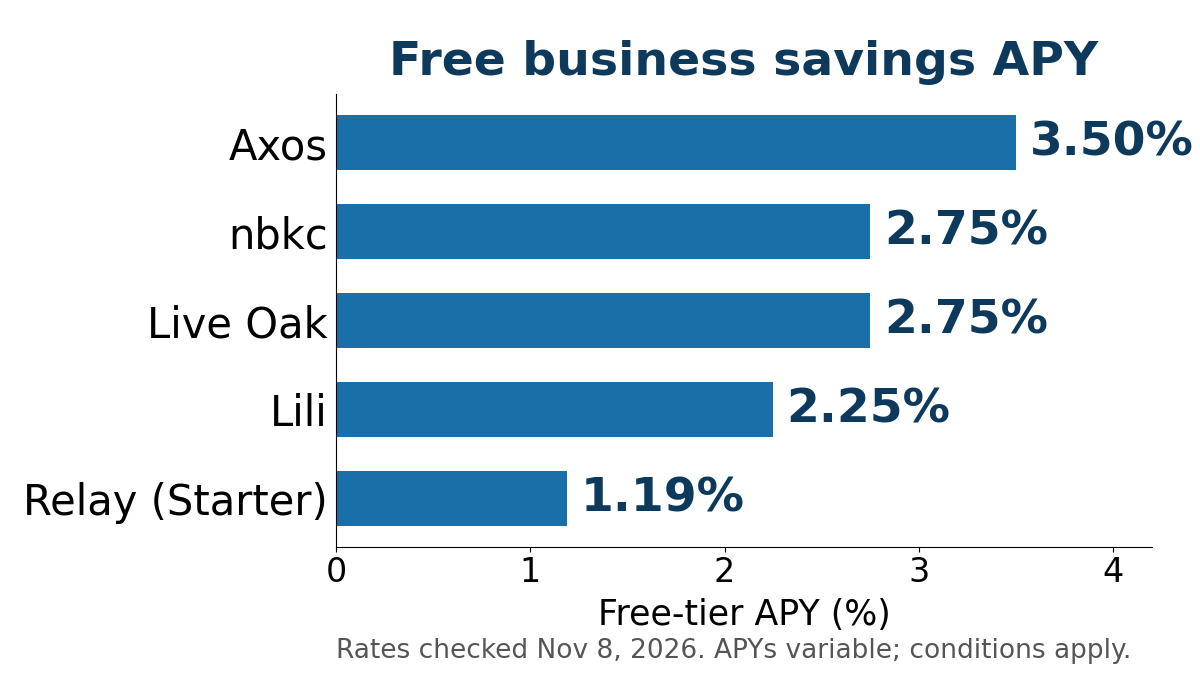
| Account | Free-tier APY (Nov 8, 2026) |
|---|---|
| Axos Bank Business Premium Savings | 3.50% * |
| nbkc Business Money Market | 2.75% |
| Live Oak Bank Business Savings | 2.75% |
| Lili Savings | 2.25% * |
| Relay Business Savings (Starter plan) | 1.19% |
All five accounts have no monthly maintenance fee on the free tier or plan shown. * Axos pays a limited-time boosted rate of up to 3.91% APY for up to 6 months when savings is bundled with its Basic Business Checking (promo code BOOST41 and a $5,000 average daily checking balance); the standard 3.50% applies otherwise and afterwards. Lili pays 2.25% APY on balances up to $500,000, 4.00% APY on the portion from $500,000 to $1,000,000, and no interest above $1,000,000. Axos Bank, nbkc bank and Live Oak Bank hold deposits directly as Member FDIC banks; Lili deposits are held through Sunrise Banks, N.A. and Relay deposits through Thread Bank, both Member FDIC, with sweep-network coverage subject to pass-through conditions.
1. Axos Bank Business Premium Savings: highest standard rate, no monthly fee
Axos Bank’s Business Premium Savings paid 3.50% APY on every balance tier under $5 million at the November 8, 2026 check of its rate table. There is no monthly maintenance fee, no minimum opening deposit and no average daily balance requirement for the standard rate. Axos is a bank, so deposits are FDIC-insured up to the standard $250,000 per depositor, per ownership category; its Insured Cash Sweep option extends coverage through the IntraFi network for larger balances.
The advertised “up to 3.91% APY” is a limited-time boost, not the standard rate. It requires opening Business Premium Savings together with a Basic Business Checking account, entering promo code BOOST41 at enrollment, and keeping an average daily balance of at least $5,000 in the checking account; the boost lasts up to 6 months before the account returns to the standard rate. Treat the standard 3.50% as the number to plan around. Axos accepts sole proprietors – its application asks for a Social Security number if you are a sole proprietor rather than an EIN-only business. Free incoming domestic and international wires are a genuine plus for moving client payments into savings. Check the current Axos rate page before opening.
2. nbkc Business Money Market: 2.75% on every dollar, from a full-service bank
nbkc’s Business Money Market account paid 2.75% APY on all balances at the bank’s posted rates effective November 7, 2026, with interest from a $0.01 balance and no minimum opening deposit. It is technically a money market account rather than a savings account; for a reserve fund the practical difference is small, and the account comes from nbkc bank, a Member FDIC institution in Kansas City.
The fee list is unusually clean for reserve cash: no monthly fee, no overdraft or NSF fees, no charge for incoming domestic wires, stop payments or mobile check deposits. Required documents vary by entity type and state during the online application, so a sole proprietor should have formation and ID documents ready when the application asks. Confirm current terms on the nbkc money market page.
3. Live Oak Bank Business Savings: 2.75% with extended coverage options
Live Oak Bank’s Business Savings paid 2.75% APY at the November 8, 2026 check of its product page. The bank’s business fee schedule (effective July 21, 2025) lists no monthly account fee. Live Oak is an FDIC member bank, and it offers access to extended FDIC coverage through the IntraFi network at no extra cost for balances beyond the standard limit – pass-through coverage is subject to conditions, as it is everywhere.
The fees to know: incoming wires cost $10, outgoing domestic wires $19, and an account with no activity for 24 consecutive months starts drawing a dormant fee from the 25th month. A tax reserve that receives a transfer every quarter will never go dormant, but a forgotten account can. See the Live Oak business savings page for current rates.
4. Lili Savings: tiered rate, free on the $0 Core plan, built for freelancers
Lili’s savings account is available on every Lili plan, including the free Core plan with no monthly fee. At the rates effective January 13, 2026 shown on its page, savings earn 2.25% APY on balances up to and including $500,000 and 4.00% APY on the portion from $500,000 to $1,000,000, with no interest above $1,000,000. Interest starts at a $0.01 balance. Lili is a financial technology company, not a bank; banking services are provided by Sunrise Banks, N.A., Member FDIC, and savings deposits are insured up to $3,000,000 through Sunrise Banks’ sweep network, subject to pass-through conditions.
For a freelancer already using Lili for checking and tax buckets, opening savings takes no separate application. The tiered structure means the headline 4.00% applies only above $500,000, which most freelancers will not hold in one account – plan around the 2.25% tier. Details are on the Lili savings page.
5. Relay Business Savings: structured reserves on the $0 Starter plan
Relay lets a business open up to two savings accounts, which suits a freelancer who wants one account for taxes and one for emergencies. On the $0-per-month Starter plan, savings earned 1.19% APY at the November 8, 2026 check; the paid Grow and Scale plans raised that to 1.87% and 3.21%. Interest accrues from the first dollar, is paid monthly, and there are no minimum balances. Relay is a fintech, not a bank; deposits are held through Thread Bank, Member FDIC, with up to $3,000,000 in coverage through its sweep program, subject to pass-through conditions.
One deliberate restriction: money in Relay savings cannot be spent by card or external payment, which enforces the point of a reserve but means you must transfer back to checking before paying a tax bill. Auto-transfer rules can sweep idle checking cash into savings on a schedule. The lower Starter APY is the trade-off for the structure. Current rates are on the Relay savings page.
How to choose
For a pure rate on reserve cash, the three banks – Axos, nbkc and Live Oak – pay more than the fintech free tiers at the November 8, 2026 check, and they hold your deposits directly rather than through a sweep network. The fintech options make sense when you already use them for checking and value one login and automatic transfers over the rate gap: Relay at 1.19% on its free plan costs you about $231 a year in forgone interest per $10,000 compared with Axos at 3.50%, which is real but not life-changing money while you build the habit.
Whichever you choose, check three things on the provider’s own page before applying: the current APY (every rate here is variable), whether the headline rate needs a paid plan or bundled product (Axos’s 3.91% boost and Relay’s 3.21% Scale rate both do), and how deposits are insured – direct FDIC coverage at a bank, or pass-through coverage through a sweep network, which applies only when its conditions are met. The FDIC’s guidance on third-party apps is worth reading before keeping business money with any nonbank app.
The interest is taxable income
Interest earned on a business savings account is taxable. Banks report interest of $10 or more on Form 1099-INT, and a sole proprietor reports that interest on the personal return; see IRS Topic 403. A useful side effect: moving the tax reserve into savings does not change what you owe – our 1099 set-aside guide covers the percentage to reserve before it starts earning interest.
Frequently asked questions
Is money in a fintech savings account FDIC-insured?
The fintech app itself is not an insured bank. Deposit insurance applies when your money is held at the partner bank or placed through its sweep network and the pass-through conditions are satisfied. Check the named partner bank and the sweep terms before depositing.
Do I owe tax on business savings interest?
Yes. Interest is taxable income. Banks report interest of $10 or more on Form 1099-INT, and a sole proprietor reports the interest on the personal return.
Is a money market account the same as a savings account?
They are both deposit accounts and both can be FDIC-insured. Money market accounts sometimes carry different transaction features or rate tiers. The nbkc account in this guide is a money market account that pays 2.75% APY on all balances at the November 2026 check.