

You have your business bank account open, your LLC paperwork is filed, and your client contracts are finally bulletproof. Now, it is time to turn your everyday business expenses into pure profit.
If you are still using your personal credit card to pay for your website hosting, software subscriptions, or that new MacBook, you are making a massive mistake. Not only are you creating a bookkeeping nightmare for tax season, but you are also missing out on thousands of dollars in free cash back and sign-up bonuses.
Getting a dedicated business credit card is the ultimate “level up” for a freelancer. The best business credit cards for freelancers cost you absolutely nothing in annual fees while simultaneously building your business credit profile, separating your finances, and rewarding you for spending money you were already planning to spend. Here are the 5 best zero-annual-fee business credit cards for 1099 contractors in 2026.
- Always Separate Your Finances: Using a dedicated business card makes tax deductions dramatically easier to identify, claim, and defend in the event of an IRS audit.
- Zero Annual Fee ≠ Zero Value: Several no-fee cards offer sign-up bonuses worth $500–$750 and ongoing cash back rates of up to 3%, making them genuinely more rewarding than many premium, fee-based alternatives.
- Build Business Credit Immediately: Applying for a business card and paying the bill on time every single month is the fastest, most reliable method for establishing a strong business credit profile with Dun & Bradstreet and Experian Business.
- Know the Personal Guarantee Risk: Almost every small business card requires a personal guarantee. Your personal credit score is on the line if your business cannot pay, so treat business debt with the same seriousness as personal debt.
In This Guide
- Why Every Freelancer Needs a Dedicated Business Card
- 1. Chase Ink Business Unlimited: Best Overall Flat-Rate
- 2. American Express Blue Business Cash: Best for Easy Approval
- 3. Capital One Spark 1.5% Cash Select: Best for Simple Bookkeeping
- 4. Bank of America Business Advantage Customized Cash: Best for Software Budgets
- 5. U.S. Bank Business Triple Cash Rewards: Best for 0% Financing
- The Personal Guarantee: What Every Freelancer Must Understand
- Which Card Belongs in Your Wallet?
- Frequently Asked Questions (FAQ)
Why Every Freelancer Needs a Dedicated Business Card
The IRS draws a very clear line between personal expenses and legitimate business deductions. When you pay for Adobe Creative Cloud, your home office internet, or a new client proposal on the same personal Visa card you use for groceries and Netflix, that line becomes impossibly blurry. Come April, you or your accountant will be forced to sort through twelve months of combined personal and professional spending, a process that wastes enormous amounts of time and inevitably causes you to miss deductions you are legally entitled to claim.
A dedicated business credit card solves this problem completely and automatically. Every single charge on that card is a business expense, period. Your year-end bookkeeping goes from a chaotic, all-night spreadsheet session to a clean, one-click export. More importantly, you are rewarded for making the switch.
According to the Federal Reserve’s 2024 Small Business Credit Survey, small business owners who use dedicated business credit cards consistently report better cash flow management and stronger business credit scores than those who rely on personal cards. The best part is that the five cards below accomplish all of this at zero cost in annual fees.
1. Chase Ink Business Unlimited: Best Overall Flat-Rate
The Chase Ink Business Unlimited is widely considered the undisputed heavyweight champion for freelancers who want massive, no-hassle rewards. It is simple, highly rewarding, and gets you into the incredibly valuable Chase Ultimate Rewards ecosystem, which is widely regarded as the most flexible and lucrative rewards currency in the entire credit card industry.
- The Rewards: An unlimited, flat 1.5% cash back on every single purchase you make. No categories to track, no spending caps, no quarterly activations required.
- The 2026 Edge: Chase consistently offers massive sign-up bonuses—often around $750 cash back when you hit a minimum spend requirement of approximately $6,000 in the first three months—which is practically unheard of for a card with absolutely no annual fee.
- The Hidden Power: If you also hold a premium Chase card like the Sapphire Preferred or Sapphire Reserve, you can transfer the points you earn on the Ink Business Unlimited into airline miles or hotel points at a 1:1 ratio, potentially multiplying their value to 2 cents or more per point when redeemed for travel.
For most freelancers—especially those just starting to build their business credit profile—the Chase Ink Business Unlimited is the obvious first choice. The combination of a generous ongoing cash back rate and an industry-leading sign-up bonus makes it the most rewarding no-fee card available in 2026.
2. American Express Blue Business Cash: Best for Easy Approval
If your freelance income is relatively new, inconsistent from month to month, or your personal credit history is not yet stellar, American Express is notoriously more freelancer-friendly than Chase when it comes to underwriting approvals. The Blue Business Cash card acts as a fantastic financial safety net with a genuinely unique built-in flexibility feature.
- The Rewards: 2% cash back automatically credited to your statement balance on all eligible purchases up to $50,000 per calendar year, then 1% after that. For the average freelancer spending well under $50,000 annually on business expenses, this is an effective 2% flat-rate card.
- The 2026 Edge: This card features American Express’s proprietary “Expanded Buying Power” feature. Amex allows you to spend above your set credit limit to make large, unexpected business purchases—such as emergency equipment replacements, urgent software licenses, or last-minute travel for an important client meeting—without immediately declining your card or triggering an over-limit fee.
- The Catch: The amount above your credit limit that Amex will approve varies based on your payment history, credit scores, and overall spending patterns. It is not unlimited, but it provides a meaningful cushion that fixed-limit cards simply cannot offer.
The Blue Business Cash is an excellent option for newer freelancers who want a straightforward 2% rewards rate on all their spending without the complexity of rotating bonus categories. Pair it with strong bookkeeping software and the Expanded Buying Power feature becomes a reliable emergency fund of sorts for your business operations.
Every card listed in this guide exports your transaction data in a format compatible with QuickBooks, Wave, and FreshBooks. The moment you set up automatic transaction syncing between your business card and your bookkeeping software, your profit and loss report stays updated in real time and your quarterly estimated taxes practically calculate themselves. Check out our guide to the 5 Best Invoicing & Bookkeeping Tools for Freelancers to get this pipeline running today.
3. Capital One Spark 1.5% Cash Select: Best for Simple Bookkeeping
Capital One has invested heavily in making its business banking products the most technologically seamless on the market, and the Spark 1.5% Cash Select card is the clearest example of that commitment. It is famous not just for its competitive cash back rate, but for its hyper-clean app interface and its seamless, native integrations with almost every major bookkeeping software on the market, including Wave Accounting and QuickBooks Online.
- The Rewards: A solid, unlimited 1.5% cash back on every single purchase with no categories, no caps, and no annual fee eating into your returns. Capital One deposits your earned cash back automatically, which you can redeem as a statement credit or a check.
- The 2026 Edge: Absolutely zero foreign transaction fees on every international purchase. If you are a “digital nomad” freelancer who travels internationally, outsources work to contractors in other countries, or regularly pays for software services hosted and billed from Europe or Asia, this card saves you the standard 3% foreign transaction fee that most other cards charge on every single overseas swipe or charge.
- The Approval Angle: Capital One uses a unique dual-bureau credit check process during the application review, pulling from both TransUnion and Equifax simultaneously. Be aware of this before applying.
For freelancers who work with international clients, pay for tools billed in foreign currencies, or simply want the cleanest possible app experience linked to their business bank account, the Capital One Spark Cash Select is the most practical daily-driver card on this list.
4. Bank of America Business Advantage Customized Cash: Best for Software Budgets
If you are a web designer, developer, digital marketer, or content creator who spends a substantial portion of your business budget on internet advertising, web hosting, SaaS tools, or cloud computing services, the Bank of America Business Advantage Customized Cash card is built specifically for your spending profile. It lets you choose your own adventure by selecting your highest-earning bonus category from a curated list of six options.
- The Rewards: 3% cash back in the single category of your choice (available options include: computer services and software, office supply stores, travel, TV/telecom/internet/wireless, restaurant purchases, or gas stations), plus an automatic 2% cash back on all dining purchases, and 1% on everything else. The 3% and 2% bonuses apply on combined purchases up to $50,000 each calendar year.
- The 2026 Edge: The “computer services” category is an absolute goldmine for tech-forward freelancers. It covers charges from Adobe, AWS, Google Workspace, Squarespace, Shopify, and most major SaaS platforms. Earning 3% back on tools you were already paying for every single month is one of the most powerful passive income streams available to a solo operator.
- The Loyalty Bonus: If you maintain a Bank of America business checking or savings account with a qualifying balance, you can unlock a Preferred Rewards for Business tier that boosts your cash back percentages by an additional 25% to 75%, turning that 3% category into an effective 5.25% for the highest tier members.
For freelancers who spend more than $1,000 per month on software subscriptions and internet services, the Bank of America Business Advantage Customized Cash card can easily generate $360 or more in annual cash back from that single category alone—at absolutely no cost in annual fees.
5. U.S. Bank Business Triple Cash Rewards: Best for 0% Financing
If you are launching a new freelance operation and need to finance a significant upfront equipment investment—such as a professional camera rig, a high-performance editing workstation, or an ergonomic standing desk setup for a home office—this is the single most powerful financial tool available to you in 2026. Paying 20% or more in credit card interest to finance essential business gear is one of the biggest financial mistakes a new freelancer can make, and this card eliminates that risk entirely.
- The Rewards: 3% cash back at eligible gas stations, office supply stores, cell phone service providers, and electric vehicle charging stations. An automatic 1% cash back on all other purchases. These categories are particularly strong for freelancers who rely on their smartphone as a primary business tool or who make frequent office supply purchases.
- The 2026 Edge: The U.S. Bank Business Triple Cash Rewards card features one of the longest 0% introductory APR periods currently available on the market for business credit cards—typically offered for the first 12 months on purchases and balance transfers. This means you can buy an expensive piece of professional equipment today, spread the payments out over a full calendar year, and pay absolutely zero dollars in interest charges. When used strategically, this is literally free financing.
- The Math: Financing a $3,000 camera upgrade over 12 months at 0% costs you $250 per month with zero additional fees. Financing that same camera on a standard card at 24% APR would cost you approximately $400 in pure interest over the same period. That $400 is pure profit you keep in your pocket with the U.S. Bank card.
Once the introductory 0% APR period ends after the first year, the ongoing variable APR kicks in at a higher rate, so make absolutely certain you have a disciplined plan to pay off any financed balance before the promotional period expires. Used responsibly, this card is a legitimate zero-cost financing tool for growing your freelance business infrastructure.
Even if you have an LLC and an EIN, almost every business credit card requires a “Personal Guarantee.” This means that if your freelance business cannot pay the credit card bill, the bank will legally come after your personal credit score and personal assets. This is fundamentally different from how a true corporate liability shield works. Always treat business debt with extreme personal caution—and consider reviewing Sole Proprietor vs. LLC: What Freelancers Need to Know to fully understand what an LLC can and cannot protect you from.
The Personal Guarantee: What Every Freelancer Must Understand
Before you submit an application for any business credit card listed in this guide, there is one critically important legal concept you must fully understand: the personal guarantee. This is not fine print you can safely ignore. It is a legally binding commitment that makes you personally and financially responsible for every dollar charged to the business card, regardless of your business structure.
When you sign a business credit card application, you are agreeing that if your freelance business falls on hard times, loses major clients, or simply cannot generate enough revenue to service the debt, the bank has the full legal right to report the delinquency to your personal credit bureaus and pursue collection against your personal assets. Your personal credit score, your personal savings account, and in some cases even your personal property can be targeted by the lender.
This does not mean you should avoid business credit cards—quite the opposite. It means you should use them with the same disciplined financial responsibility you apply to your personal finances. Never charge more to your business card than your business can realistically pay back within the same billing cycle. Build your emergency fund first, as outlined in our guide to the best free business bank accounts for freelancers, and always treat your business card bill as the single highest financial priority in your monthly budget.
Which Card Belongs in Your Wallet?
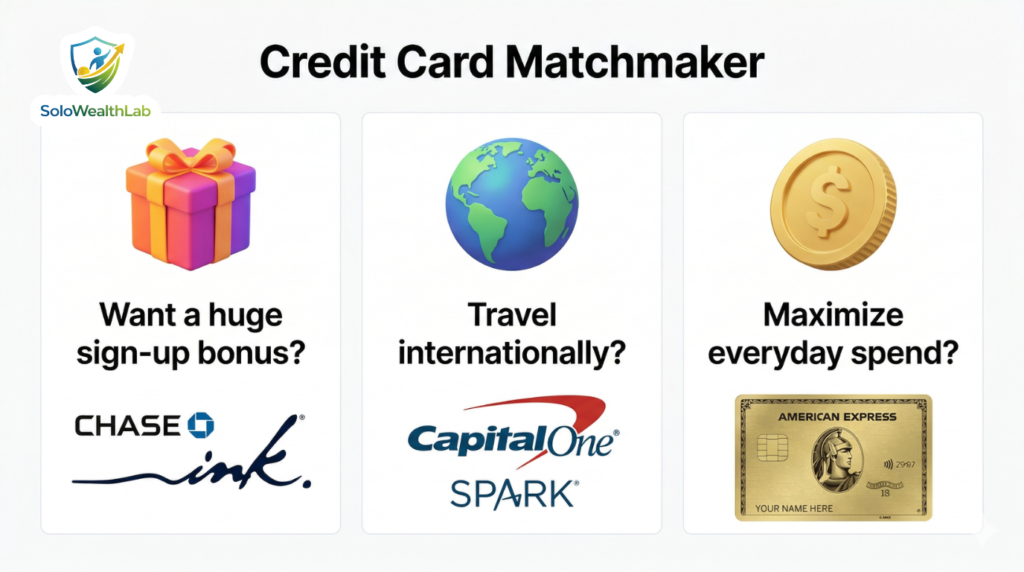
Choosing among the best business credit cards for freelancers comes down to one simple question: what does your business spend the most money on?
If you want the absolute easiest, most rewarding experience with the largest available sign-up bonus, get the Chase Ink Business Unlimited. Its $750 welcome offer combined with unlimited 1.5% flat-rate cash back makes it the default best choice for the majority of freelancers who do not have a specific category where they concentrate their spending.
If you are a newer freelancer who needs a more accessible approval process, choose the American Express Blue Business Cash for its 2% flat rate and the peace of mind that comes with Expanded Buying Power during unexpected business emergencies.
If you travel internationally, work with overseas clients, or pay for software billed in foreign currencies, the Capital One Spark 1.5% Cash Select eliminates the 3% foreign transaction fee that will otherwise quietly drain your profits on every international charge.
If your biggest monthly expense is software subscriptions, web hosting, or digital advertising, the Bank of America Business Advantage Customized Cash and its 3% category bonus will generate more cash back on your specific spending than any other card on this list.
And if you are a new freelancer who needs to finance essential equipment purchases over time without paying a single dollar in interest, the U.S. Bank Business Triple Cash Rewards is your most powerful tool in that first critical year of building your operation.
Pick the one card that best matches your specific spending profile, stop using your personal card for business expenses today, and start letting the banks pay you for running your business. The IRS will thank you at tax time, your bookkeeper will thank you at year-end, and your wallet will thank you every single month when that cash back hits your statement.
Frequently Asked Questions (FAQ)
Can I get a business credit card as a sole proprietor with no LLC?
Yes, absolutely. You do not need an LLC or any other formal business entity to apply for a business credit card. All five cards listed in this guide allow sole proprietors and independent contractors to apply using their Social Security Number (SSN) in place of an EIN. Your existing freelance work and self-employment activity legally qualifies as a business for the purposes of these card applications.
Will applying for a business credit card hurt my personal credit score?
The initial application will result in a hard inquiry on your personal credit report, which may temporarily reduce your score by a few points for up to 12 months. However, most major business cards—particularly those issued by Chase and American Express—do not report your ongoing business card balance and utilization to the personal credit bureaus on a monthly basis. This means your business spending does not inflate your personal credit utilization ratio over time, which is a significant advantage over using personal cards for business expenses.
What credit score do I need to qualify for a business credit card?
Most of the no-annual-fee business cards in this guide require a good to excellent personal credit score, generally in the 670–740 range or higher. The Chase Ink Business Unlimited typically requires the strongest credit profile (720+ recommended), while American Express tends to be the most flexible approver for scores in the 670–700 range with solid income. Always confirm the current specific requirements on the issuer’s official website before submitting your application.
How does a business credit card help at tax time?
A dedicated business credit card automatically creates a clean, year-long paper trail of every single qualified business expense. At tax time, you can export your entire twelve months of transaction history in a single statement, making it dramatically easier to identify Schedule C deductions and calculate your total business expenses. This hard separation between personal and business spending is also your single strongest defense if the IRS ever audits your claimed business deductions.
Should I get one business credit card or multiple?
Most financial advisors recommend starting with a single business card and building a consistent 12-month history of on-time payments before adding a second card. Once you clearly understand where your business concentrates its monthly spending, you can strategically layer a second card that earns a higher bonus rate in your top category. Avoid opening multiple cards simultaneously, as back-to-back hard inquiries can temporarily suppress your credit score and the added complexity increases the risk of missed payments.