
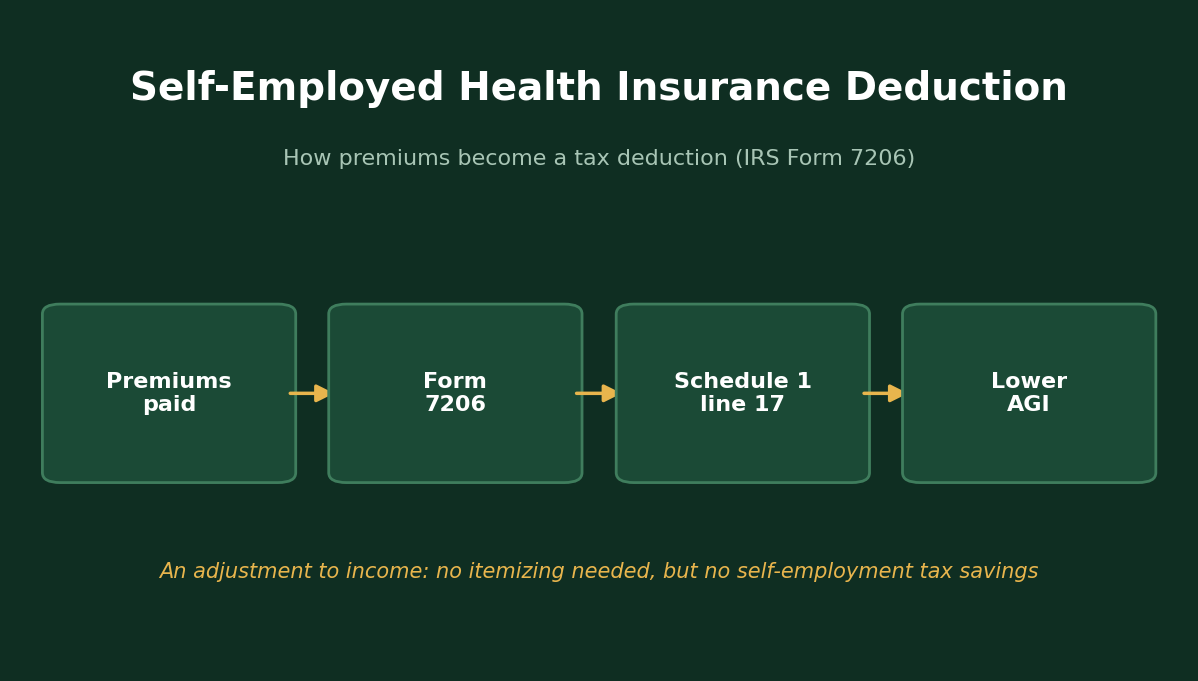
If you buy your own health insurance as a freelancer, the self-employed health insurance deduction is usually the single largest adjustment to income available to you. It lets you deduct premiums for medical, dental, vision and qualified long-term care coverage before adjusted gross income, so it lowers your income tax whether or not you itemize. The rules come from the IRS instructions for Form 7206, and a few of them trip people up: an eligibility test that runs month by month, a profit limit, and a specific interaction with the Marketplace premium tax credit.
Who qualifies
You can take the deduction if one of these is true for the year:
- You were self-employed with a net profit reported on Schedule C or Schedule F.
- You were a partner with net earnings from self-employment reported in box 14, code A of Schedule K-1.
- You used an optional method to figure net earnings from self-employment on Schedule SE.
- You were a more-than-2% shareholder in an S corporation and received wages from it, with the premiums paid or reimbursed by the S corporation and reported on your W-2.
The insurance plan must be established, or considered established, under your business. For a sole proprietor filing Schedule C, the policy can be in your own name or the business name; both count. Partners and S corporation shareholders have stricter rules: if the policy is in your name and you pay it yourself, the partnership or S corporation must reimburse you and report the amount correctly for the plan to count.
What premiums count
The deduction covers premiums for medical, dental and vision insurance, plus qualified long-term care insurance, for:
- you,
- your spouse,
- your dependents, and
- any child who was under age 27 at the end of the tax year, even if that child is not your dependent.
Long-term care premiums are capped by the insured person’s age at year end. For 2026 returns, the per-person limits range from $500 (age 40 or younger) to $6,200 (over 70). For 2025 returns they ranged from $480 to $6,020. Medical, dental and vision premiums have no such cap.
The month-by-month employer rule
This is the condition most often missed. You cannot deduct premiums for any month in which you were eligible to participate in a health plan subsidized by an employer. That includes your own employer if you also have a job, your spouse’s employer, and even the employer of your dependent or your child under 27. Eligibility alone blocks the month. It does not matter whether you actually enrolled, and it does not matter whether the employer plan was a good deal.
The test runs month by month, so a mid-year change splits the year. Say your spouse started a job in August and you could have joined that plan from August 1. Your January-through-July premiums can still qualify; August through December cannot. If part-year W-2 work is in the picture, our guide to setting aside taxes on 1099 income helps with the income side of the same transition.
The net profit limit
The deduction cannot exceed your earned income from the business the plan is tied to. For a Schedule C filer, that is the net profit from that business. A year with a small profit produces a small deduction, and the deduction cannot turn a profit into a loss. If you run more than one business, each plan’s deduction is limited by the earnings of its own business, figured on a separate Form 7206.
Premiums that exceed the limit are not lost entirely: amounts you cannot deduct here can be included as medical expenses on Schedule A if you itemize, subject to the usual medical-expense floor.
How it interacts with the premium tax credit
Many freelancers both buy a Marketplace plan with a subsidy and qualify for this deduction. The same premium dollars cannot be used twice, so when both apply, the calculation feeds into itself: the deduction lowers adjusted gross income, which changes the premium tax credit, which changes the net premium, which changes the deduction. IRS Publication 974 exists largely for this case, and tax software handles the iteration.
Two practical consequences:
- Only the premiums you actually paid out of pocket after the credit belong in the deduction. The subsidized portion is already a benefit.
- Because the deduction lowers AGI, it also lowers the household income figure the Marketplace uses for the credit. With the subsidy cliff back at 400% of the federal poverty level for 2027 coverage, that can matter near the cutoff.
If you are weighing a Marketplace plan for next year, our 2027 open enrollment guide covers the dates and the current subsidy rules; this article covers the tax-filing side.
How to claim it
The deduction is figured on Form 7206 and reported on Schedule 1 of Form 1040, line 17. That makes it an adjustment to income rather than an itemized deduction, so it reduces your adjusted gross income even if you take the standard deduction. One thing it does not do: it does not reduce self-employment tax. Schedule SE is computed from business profit without this deduction.
It also sits alongside, not inside, your other freelancer deductions. The 1099 deductions cheat sheet shows how it combines with retirement contributions, the home office deduction and the QBI deduction, and the estimated tax guide covers how to reflect it in quarterly payments.
Frequently asked questions
Can a sole proprietor deduct health insurance premiums?
Yes, if the Schedule C business has a net profit and no employer subsidized plan was available for the months claimed. The policy can be in the individual or business name, and the deduction is limited to the profit from that business.
Does the self-employed health insurance deduction reduce self-employment tax?
No. It lowers adjusted gross income for income tax purposes, but self-employment tax is computed from business profit on Schedule SE without subtracting this deduction.
What if my spouse could add me to an employer plan?
Any month you were eligible to join that plan is blocked from the deduction, even if you never enrolled. Months before or after that eligibility can still qualify, because the test runs month by month.
Can I deduct premiums for months I had a Marketplace subsidy?
You can deduct only the net premiums you actually paid after the premium tax credit. When both benefits apply, IRS Publication 974 provides the method that splits the premiums between them, and tax software handles it.
Where does the deduction go on the tax return?
It is figured on Form 7206 and reported on Schedule 1 of Form 1040, line 17, as an adjustment to income. You do not need to itemize to claim it.