
December is supposed to be a time to relax, celebrate, and recharge for the new year. Gatherings, holidays, and taking a step back from the daily grind are the hallmarks of the season. But for a 1099 freelancer, independent contractor, or solo business owner, December 31st is a hard, unyielding deadline. Once the clock strikes midnight, your tax year is officially sealed—and so is your financial fate with the IRS for the year.
If you wait until tax season in April to think about your business finances, you are far too late to make any meaningful changes. The retroactive moves you can make after the calendar turns are incredibly limited. However, by executing a few highly strategic moves in November and December, you can legally slash your tax liability by thousands of dollars, organize your bookkeeping, and start the new year with massive momentum.
As a freelancer, you don’t have an HR department, a built-in benefits team, or a corporate accounting firm to handle this for you behind the scenes. You are the CEO, and you have to be radically proactive. That’s why we have put together this comprehensive guide.
Here is your ultimate year-end financial checklist for freelancers to lock in your profits, legally minimize your 2026 tax bill, and protect the solo business you have worked so hard to build.
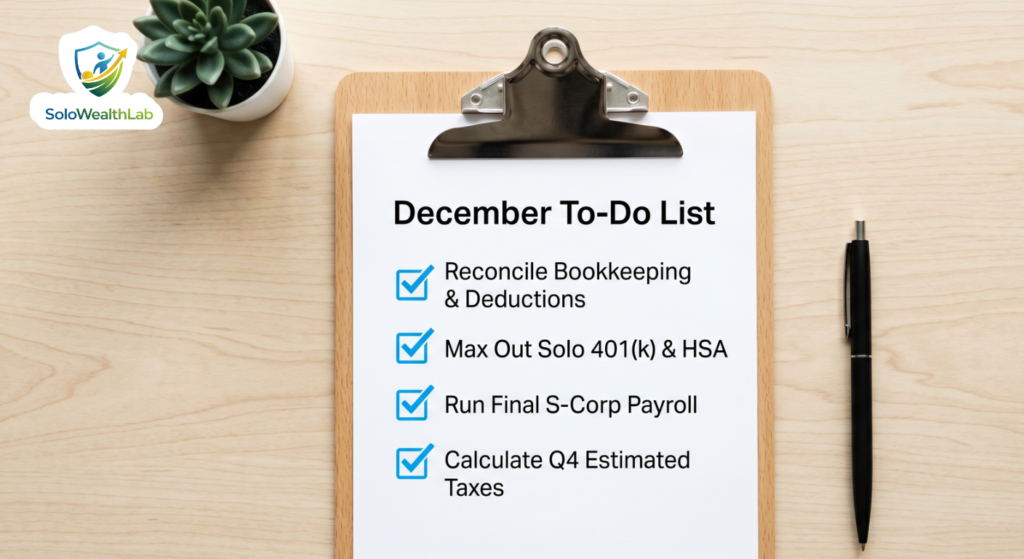
- Act Before Dec 31st: Most high-impact tax-saving strategies, like prepaying expenses or funding certain retirement accounts, strictly must be completed before the calendar turns.
- Maximize Lawful Deductions: Hunt down every eligible business expense, reconcile your business credit cards, and strategically stock up on essential supplies for the upcoming year.
- Pay Your Future Self First: Maxing out your Solo 401(k), SEP IRA, or HSA is arguably the most mathematically effective way to lower your taxable net income instantly.
- S-Corp Deadlines Are Absolute: If you elect S-Corp status, running your final W-2 payroll in December is non-negotiable to stay compliant with the IRS and avoid catastrophic penalties.
In This Guide
- 1. Reconcile Your Books and Chase Final Invoices
- 2. Pre-Pay Expenses & Defer Income (Cash Basis Hacks)
- 3. Max Out Your Tax-Advantaged Accounts
- 4. Run Final S-Corp Payroll (If Applicable)
- 5. Audit Your Risk Management & Contracts
- 6. Prepare 1099-NECs for Your Subcontractors
- 7. Calculate Your Q4 Estimated Tax Payment
- 8. Conduct a Client Audit and Plan Rate Increases
- Close the Books and Celebrate
- Frequently Asked Questions (FAQ)
1. Reconcile Your Books and Chase Final Invoices
You cannot make smart, strategic tax decisions if you are flying blind. You need to know exactly how much money you made, how much you spent, and what your total profit is. Your absolute first step at year-end is to bring your bookkeeping completely up to date.
Whether you rely on manual spreadsheets or dedicated accounting software like QuickBooks Self-Employed, Xero, or Wave, you need an accurate, reconciled Profit & Loss (P&L) statement to evaluate where you stand.
Categorize Every Single Transaction
Comb through your statements and make sure every swipe of your business credit card and every transfer in your business bank account is categorized flawlessly. Look out for forgotten software subscriptions, digital advertising ad spend, marketing tools, business lunches, travel expenses, or home office purchases. Every dollar of legitimate business expense you uncover lowers your taxable net income.
Chase Unpaid Invoices (The “December Squeeze”)
If a client securely owes you money, send a polite but firm reminder right now. You want that cash deposited into your business checking account before the year officially closes. This ensures you have the liquidity and cash flow needed to fund your retirement accounts and safely cover your estimated tax liabilities. Outstanding invoices—or Accounts Receivable sitting in the ether—do not help you pay the bills today.
2. Pre-Pay Expenses & Defer Income (Cash Basis Hacks)
Most freelancers and sole proprietors operate on what is called Cash Basis Accounting. This means you record income when it physically hits your bank account (not when you send the invoice) and you record expenses when the money leaves your account (not when you receive the bill). This opens up a massive, entirely legal opportunity for tax manipulation in late December.
The Expense Acceleration Strategy
If you have had a highly profitable year and want to minimize your tax bill, you can manufacture proactive 1099 tax deductions by buying items or services in December that you were planning to buy next year anyway.
- Upgraded Tech: Buy that new MacBook Pro, high-end camera equipment, ergonomic office chair, or dual-monitor setup you desperately need.
- Annual Subscriptions: Instead of paying monthly for Adobe Creative Cloud, web hosting wrappers, CRM software, or scheduling tools, prepay for the entire annual plan in December.
- Education and Coaching: Register and pay for industry conferences, mastermind groups, or online courses taking place next year.
- Office Supplies & Marketing: Stock up on printer ink, notebooks, shipping materials, or direct mail inventory. If you need a website redesign, pay the deposit before the year ends.
The Income Deferral Strategy
On the flip side, if you want to push income into the next tax year (perhaps you anticipate being in a lower tax bracket next year, or you just want to delay the tax bill for 12 months), you can delay invoicing your clients. If you finish a massive project on December 20th, hold off and wait until January 1st to send the invoice. The client pays you in January, meaning that income counts toward the 2027 tax year.
3. Max Out Your Tax-Advantaged Accounts
The single best defensive strategy in a year-end financial checklist for freelancers is paying your future self before you pay the IRS. Any money you directly contribute to an eligible traditional retirement account is generally deducted right off the top of your taxable income.
The Solo 401(k) and SEP IRA Powerplay
As a solopreneur, you have access to incredible retirement vehicles that standard W-2 employees can only dream of. If you have a Solo 401(k), you act as both the employee and the employer.
In 2026, employee contribution limits are incredibly generous, and your business can make additional profit-sharing contributions on top of that employee deferral. Try to aggressively push as much cash into these accounts as your budget allows before the deadline. (Note: While SEP IRA contributions can generally be made up until your tax filing day, a Solo 401(k) must often be formally established before December 31st to successfully capture employee deferrals for that tax year).
The HSA Triple-Tax Advantage
If you have a High Deductible Health Plan (HDHP), do not overlook your Health Savings Account (HSA). HSAs are universally considered the holy grail of financial planning because they are uniquely triple-tax-advantaged: your contributions are tax-deductible, the growth is tax-free when invested, and the withdrawals for qualified medical expenses are tax-free. Max out your 2026 family or individual contribution limit to instantly slash your Adjusted Gross Income (AGI).
4. Run Final S-Corp Payroll (If Applicable)
If your freelance business operates as a standard single-member LLC or a Sole Proprietorship, you can comfortably skip this part of the checklist. But if you have leveled up your tax strategy and made the formal S-Corp tax election to save big on self-employment taxes, you must act decisively before December draws to a close.
As an S-Corp owner, you are legally considered an employee of your own corporation in the eyes of the government. The IRS absolutely requires you to pay yourself a “reasonable salary” via standard W-2 payroll, separate from the owner’s draws or shareholder distributions you take throughout the year.
You must log into your chosen payroll provider (such as Gusto, OnPay, or ADP) and ensure your final paycheck for the year has been thoroughly run, with the proper federal, state, Medicare, and Social Security taxes correctly withheld. If you extract a massive chunk of shareholder distributions throughout the year but negligently forget to run your W-2 payroll by December 31st, the IRS will eventually hit you with severe penalties and aggressively reclassify your distributions into taxable wages, wiping out your hard-earned tax savings.
If your S-Corp had an exceptionally profitable Q4, you might want to consider running a year-end “bonus” payroll for yourself to increase your W-2 wages. This strategic move can allow you to make larger employer-side Solo 401(k) profit-sharing contributions, as those are fundamentally calculated as a percentage of your W-2 salary, not your overall holistic S-Corp profit.
5. Audit Your Risk Management & Contracts
Comprehensive financial health is not just about aggressively minimizing taxes; it is equally about protecting the hard assets and reputation you have worked so tirelessly to accumulate. As your freelance footprint and client roster naturally grow, your underlying risk profile grows exponentially along with it. The lightweight legal setup that properly shielded you when you made $25,000 a year will be wholly inadequate when you break the six-figure mark.
Review and Strengthen Your Client Contracts
Reflect heavily on the pain points of the past year. Did you deal with vicious scope creep? Did a difficult client ghost you on a final milestone payment? Did endless revisions drastically reduce your hourly earning rate? Use December downtime to aggressively revise your Master Services Agreement (MSA) or standard project proposals. Ensure you update your freelance contract clauses to enforce strict professional boundaries, implement late fee penalties, mandate upfront deposits, and define clear revision limits for all new 2026 clients moving forward.
Assess Your Business Insurance Coverages
Did you recently sign massive corporate enterprise clients who contractually require higher liability limits? Did you buy $10,000 worth of sensitive new camera, computing, or podcasting gear? Contact your commercial broker and adjust your freelance business insurance policies—including your General Liability, Professional Liability (Errors & Omissions), and Commercial Property coverages—to adequately reflect your current scale and risk exposure.
6. Prepare 1099-NECs for Your Own Subcontractors
Freelancers aren’t generally just solitary workers; eventually, they scale up and become hirers. Did you outsource custom logo design to a graphic artist? Hire a virtual assistant for admin work? Pay a freelance video editor, an SEO consultant, or a ghostwriter?
If you paid any unincorporated independent contractor $600 or more via cash, physical check, or direct bank transfer (ACH) over the course of the tax year, the IRS legally requires you to issue them a Form 1099-NEC by January 31st of the new year.
Your Action Item for December:
- Thoroughly audit your P&L to rapidly identify any contractor you paid $600+.
- Ensure you have a fully completed, correctly signed W-9 form safely on file for each of them.
- If you are missing a W-9, request it right now while the contractor is still reasonably responsive, rather than scrambling in late January when they may ignore your emails.
(Important Exception: If you paid them exclusively via credit card, PayPal Business, or a similar third-party settlement network, you generally do NOT personally issue them a 1099-NEC. The payment processor issues a 1099-K to them instead, lifting that burden from you.)
7. Calculate Your Q4 Estimated Tax Payment
The transition from one business year to the next is a notoriously dangerous time for freelance cash flow stability. The festive holiday season brings an enormous influx of personal spending pressures, and it becomes incredibly tempting to quietly dip into your dedicated business tax reserves.
Remember that while the fiscal year wraps up completely on December 31st, your final mandated tax payment for that year is due a couple of weeks later (usually hovering around January 15th). Run your final, locked-in profit numbers in late December so you know precisely how much you must remit to the IRS and your state revenue portal for your Q4 Quarterly Estimated Tax Payment.
Do not accidentally spend your Q4 tax savings on extravagant holiday gifts or a tropical vacation! Firmly earmark those protected funds in a separate high-yield savings account so you are completely prepared and stress-free when the mid-January tax deadline inevitably hits.
If you worked with new clients this year, make sure you’ve submitted a W-9 to each one. This simple form provides your tax identification details so clients can correctly report your income using Form 1099. Missing or incorrect W-9 information can even trigger backup withholding of up to 24% on your payments. Learn exactly how to fill it step-by-step in our guide: How to Fill Out W-9 (2026) for Independent Contractors.
8. Conduct a Client Audit and Plan Rate Increases
The year-end period isn’t solely about tax defense—it’s also about setting your offense strategy for the new year. Take a hard, objective look at your accounting software and analyze where your money actually came from this year.
Identify your most profitable, lowest-stress clients (the 20% that bring you 80% of your joy and revenue). Conversely, identify the legacy clients who eat up your time with endless demands while paying your oldest, significantly outdated rates.
Draft your rate increase letters now. Informing your clients in mid-December that your rates will adjust slightly upward on February 1st gives them plenty of professional notice to adjust their budgets, while locking in a major raise for yourself going into 2026.
Close the Books and Celebrate
Running a freelance business is a monumental, sometimes exhausting undertaking. You are the CEO, the lead marketer, the janitor, the chief accountant, and the primary creative talent, all rolled into one resilient human being.
By taking just a few focused hours in December to execute this year-end financial checklist for freelancers, you are doing dramatically more than just saving money—you are building a massive financial moat around your operations. You are confidently transitioning from a chaotic, reactive freelancer to a structured, proactive business owner.
Once your books are fully reconciled, your retirement accounts are topped up, your S-Corp payroll is processed, and your tax deductions are locked firmly in, do the hardest thing for any ambitious self-employed person to do: close your laptop.
Step completely away from the business. Spend dedicated, unimpeded time with your loved ones. Enjoy the warm holidays. You have earned a quiet, restful slide into the new year. The hustle isn’t going anywhere—it will be right there waiting for you in January.
Frequently Asked Questions (FAQ)
What is the single most important year-end deadline for freelancers?
December 31st is the strict, unyielding deadline for most impactful tax-saving moves. If you want to legally claim a business deduction (like aggressively buying new equipment) or make certain tax-advantaged retirement contributions for the current tax year, the final financial transaction must completely clear your account before midnight on December 31st.
Can I legally deduct expenses for things I buy in December but intend to use next year?
Yes, absolutely, if you use standard cash-basis accounting (which the vast majority of solo freelancers do). You can strategically pre-pay for expenses like annual software subscriptions, business insurance policies, coaching, or physical office supplies in December, and claim the full tax deduction for the current year, even if the items are completely consumed in the following year.
Do I realistically need to send 1099s to people I hired to help me?
If you paid any unincorporated independent contractor $600 or more during the calendar year for services directly related to your business operations via cash, check, or direct bank transfer, you must issue them a Form 1099-NEC by January 31st of the following year. It is highly recommended to proactively collect their W-9 tax forms long before year-end to avoid the January rush.
What happens if an S-Corp owner forgets to run their W-2 payroll in December?
If an S-Corp business owner actively takes shareholder distributions but fails to correctly run official W-2 payroll by year-end, the IRS can aggressively reclassify all their untaxed distributions as taxable wages. This will result in severe late payment penalties, massive back-taxes for unwithheld FICA (Medicare and Social Security), and the potential outright loss of the protective S-Corp tax advantage moving forward.