
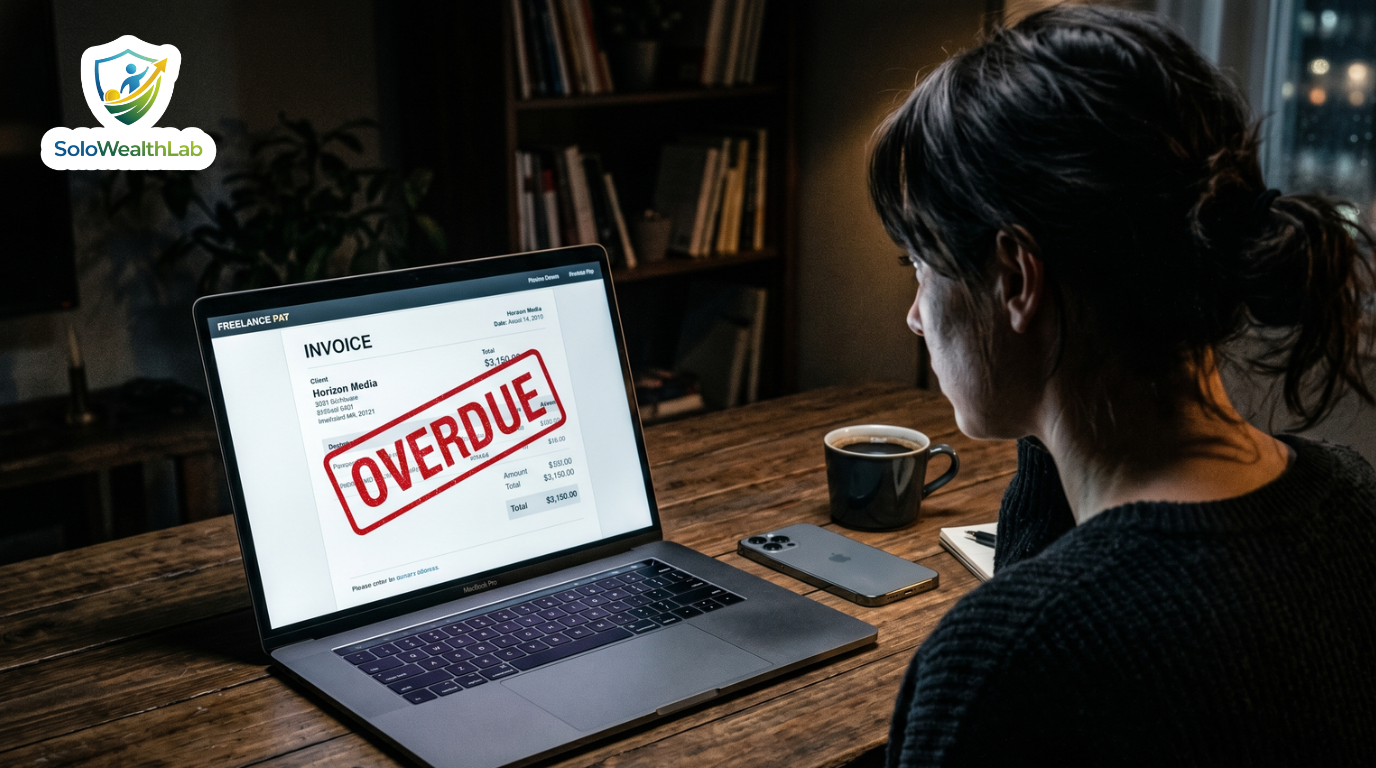
There are few things in the freelance world more panic-inducing than a past-due invoice. You did the work, you delivered it on time, and the client loved it. But now, it has been 30 days, your rent is due, and the client has completely stopped replying to your emails.
When a freelance client won’t pay, human nature tells you to panic, get angry, or send a highly emotional email. Do not do this.
To survive as a 1099 professional in 2026, you must remove emotion from your billing process. You need a cold, calculated, step-by-step escalation protocol. Unpaid invoices are an unfortunate reality of the gig economy, but how you handle them dictates whether you get paid quietly or end up burning professional bridges and losing money.
Here is the exact timeline you should follow, including copy-and-paste email scripts to get your money without ruining your reputation or wasting hundreds of hours in legal battles.
- Keep Emotions Out of It: Treat non-payment as a standard business operation issue. Emotional or angry emails destroy your leverage.
- Follow a Strict Escalation Timeline: Don’t jump straight to legal action. Use the 3-day, 14-day, and 30-day escalation protocol outlined below.
- Enforce Your Late Fees: The most effective way to stop clients from paying late is hitting them with a contractually agreed-upon late fee at the 14-day mark.
- Implement the “Stop Work” Ultimatum: Never continue working for a client who is 30 days past due. Pause all current deliverables securely until the outstanding balance clears.
- Prepare for Legal Escalation: If 60 days pass without communication, be prepared to use legal demand letters or small claims court as your ultimate safety net.
In This Guide
- Step 1: The “Benefit of the Doubt” (1 to 3 Days Late)
- Step 2: The Firm Reminder & Late Fee (14 Days Late)
- Step 3: The “Stop Work” Ultimatum (30 Days Late)
- Step 4: The Final Escalation (Small Claims & Collections)
- Preventive Measures: How to Never Chase an Invoice Again
- Protect Your Cash Flow
- Frequently Asked Questions (FAQ)
Step 1: The “Benefit of the Doubt” (1 to 3 Days Late)
In 90% of cases, your client is not trying to scam you. Their accounting department lost the email, the CEO forgot to click “approve” on the transfer, or they simply missed the deadline. Your first step when a freelance client won’t pay is to assume positive intent.
At this stage, you simply want to bring the invoice back to the top of their inbox. The tone should be extremely warm, collaborative, and entirely focused on making it as easy as possible for them to just click a button and pay you. Do not mention breach of contract or express annoyance here.
Subject: Checking in: Invoice #1045 for [Project Name]
Hi [Client Name],
I hope you are having a great week! I am just following up on Invoice #1045 for [Project Name], which was due on [Date].
I know how easily these things can get buried in an inbox, so I have re-attached the invoice here for your convenience. Please let me know if you need anything else from my end to process the payment.
Best regards,
[Your Name]
Step 2: The Firm Reminder & Late Fee (14 Days Late)
If two weeks pass and you are still met with silence, the benefit of the doubt is over. It is time to lean on the legal protections you set up during onboarding.
If you followed our guide to essential freelance contract clauses, you already agreed upon a late fee. Now is the time to apply it. This shows the client you run a real business and your boundaries are not suggestions. Many freelancers are terrified of applying a late fee because they fear it will make the client angry. However, a professional client expects standard business practices to be enforced. To alleviate your anxiety, let the contract be the bad guy, not you.
Subject: ACTION REQUIRED: Overdue Invoice #1045 and Late Fee Update
Hi [Client Name],
I am writing to inform you that Invoice #1045 is now 14 days past due.
As outlined in section 4 of our signed agreement, a late fee of 5% is applied to balances past 14 days. I have updated the attached invoice to reflect this new balance of [New Total Amount].
Please confirm receipt of this email and let me know when I can expect this payment to be processed.
Thank you,
[Your Name]
Step 3: The “Stop Work” Ultimatum (30 Days Late)
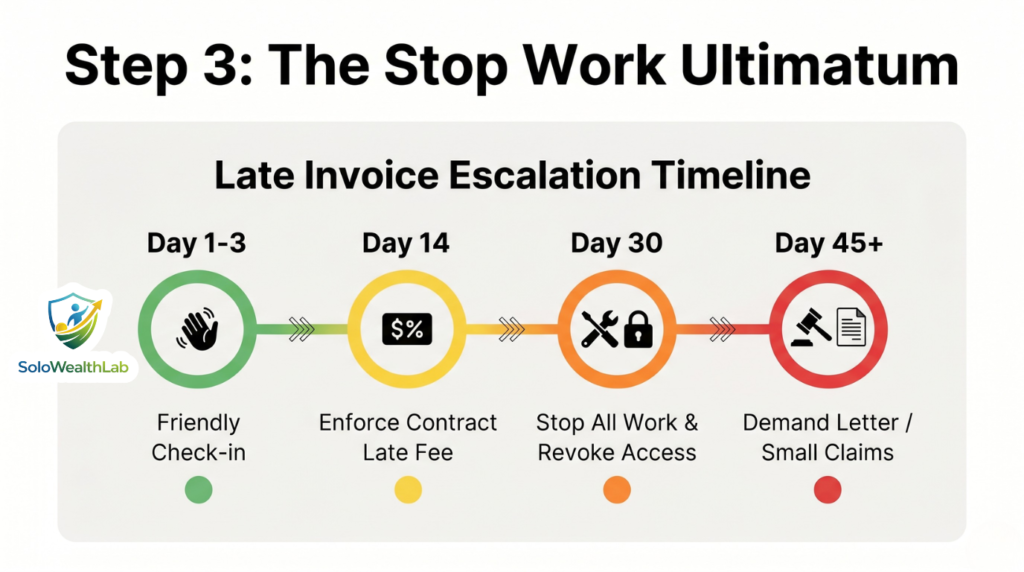
If you reach the 30-day mark, the situation has become critical. You must immediately halt all current and future work for this client. You cannot afford to keep producing value for a company that is treating you like an unpaid intern.
A surprising number of freelancers keep delivering work even when an invoice is months past due, hoping their “good faith” effort will eventually be rewarded. It won’t be. Continuing to work removes whatever remaining leverage you have. Pause access to websites, hold back final high-resolution files, and inform them that all operations are frozen.
Subject: URGENT: Work suspended due to non-payment (Invoice #1045)
Hi [Client Name],
Despite my previous follow-ups, Invoice #1045 remains unpaid at 30 days past due.
Unfortunately, I cannot continue moving forward on our current deliverables until this outstanding balance of [New Total Amount] is settled. All work has been temporarily suspended, and [transfer of final files / website access / project delivery] has been paused.
Once the invoice is cleared, I would be happy to resume the project and get us back on schedule. Please let me know how you would like to proceed.
Regards,
[Your Name]
Step 4: The Final Escalation (Small Claims, Demand Letters & Collections)
If they completely ghost you after the Stop Work notice, or if they outright refuse to pay, you have a few options to force their hand. Once an invoice goes beyond 60 days, phone calls and emails are no longer going to cut it. You must start creating a paper trail for legal action.
- Send a Formal Demand Letter: You can pay a service like LegalZoom or hire a local attorney for around $100 to $200 to draft a formal Demand Letter on legal letterhead. Often, just seeing a letter from a law firm is enough to make an accounting department magically find the money and prioritize your payment.
- Small Claims Court: If the invoice is under your state’s maximum threshold (usually between $5,000 and $10,000, depending on where you incorporate), you can file a suit in small claims court without needing an expensive lawyer. The filing fees are typically low (under $100), and winning a judgment allows you to place liens on their property or garish their accounts.
- Collections Agency: You can sell the debt to a commercial collections agency. They will aggressively pursue the client using their own resources and attorneys. The downside is that they will keep a percentage (usually 20% to 30%) of whatever they recover. However, getting 70% of something is infinitely better than getting 100% of nothing.
While you should NEVER threaten to ruin a client’s reputation directly (as this could be construed as extortion), the simple reminder that you are an independent vendor with a voice can sometimes expedite matters. If they are a B2B agency that relies on platforms like Clutch, Glassdoor, or Trustpilot, a quiet mention that you are “evaluating your options regarding public vendor reviews” will frequently push a bad client to finally close out your balance.
Preventive Measures: How to Never Chase an Invoice Again
The absolute best way to handle a client who won’t pay is to structurally prevent the situation from ever occurring in the first place. In 2026, modern freelancing relies heavily on automation and smart project scoping.
1. Always Get an Initial Deposit: Never begin a project without a financial commitment. If a client is unwilling to pay a 50% deposit (or at least a smaller retainer fee), they are a high-flight risk. The deposit ensures that even if they vanish at the end, your basic operating costs and time are somewhat covered.
2. Withhold Final Assets Until Final Payment: If you are a web designer, build the site on your own staging servers. If you are a writer, send watermarked or low-resolution PDFs of the copy. Only transfer ownership, hand over the source code, or un-restrict access to the final deliverables after the final invoice has cleared your bank account.
3. Use Modern Invoicing Software: Don’t rely on manual tracking in Excel. Use an app that allows clients to pay instantly via ACH or credit card. Set up automatic reminders in your freelance invoicing software so the software follows up on days 3, 7, and 14 automatically, removing the psychological burden from you.
Protect Your Cash Flow
Never let a client make you feel guilty for asking for your money. You run a legitimate business, and prompt payment is the lifeblood of your survival.
Set up automatic and emotionless reminders, strictly enforce your contract, and always maintain your professionalism. By sticking to this script-based escalation protocol, you train your clients to respect your boundaries, significantly reducing your stress and ensuring your cash flow remains predictable.
Frequently Asked Questions (FAQ)
Should I stop working if a freelance client hasn’t paid their invoice?
Yes. Once an invoice hits 30 days past due despite your reminders, you must halt all ongoing work immediately. Continuing to deliver work removes any leverage you have and increases the amount of money you stand to lose. Send a formal “Cease Work” notice indicating that all deliverables and communication will pause until the outstanding balance is settled.
How much can a freelancer charge for late fees?
Late fees must be explicitly outlined in your signed contract before the project begins. The standard rate is between 1.5% to 5% per month on the outstanding balance. Some freelancers charge a flat fee (e.g., $50) for invoices past 14 days. Be sure to check your state’s usury laws, which cap the maximum interest rate you can legally charge.
Is it worth suing a client in small claims court over unpaid freelance invoices?
If the invoice amount exceeds your time and filing costs (typically anything over $1,000), small claims court is highly effective. You will need a signed contract, documented email trails showing delivery of work, and records of your invoices. Filing fees are low (usually $30-$100), and winning allows you to legally compel the client to pay, sometimes through account garnishment.
What is the statute of limitations to sue a client for non-payment?
The statute of limitations for breach of a written contract depends entirely on the state in which you are filing the claim. It generally ranges from three to ten years. For oral contracts, the timeframe is frequently much shorter. Regardless, you should act well within the first 90 days, as debt becomes significantly harder to collect as it ages.
Can I publicly shame a client on social media for not paying me?
You should avoid public shaming on social media platforms like X or LinkedIn. While it might force a quick resolution, it can also lead to retaliation, and potential future clients may view you as reactionary or difficult to work with. It is also legally risky regarding defamation or extortion. Stick to professional enforcement avenues like demand letters, small claims, or verified vendor review platforms.