

- The Qualified Business Income (QBI) deduction is now permanent under the OBBBA, guaranteeing a minimum $400 deduction for eligible filers.
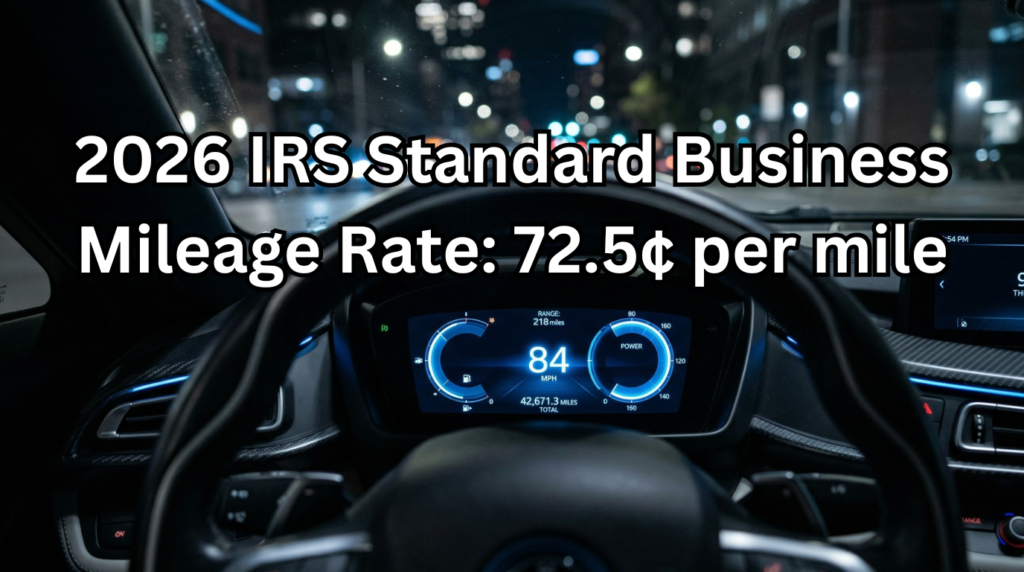
- The standard mileage rate has been aggressively increased to an unprecedented 72.5 cents per mile, providing massive savings for gig drivers.
- Gig workers can utilize restored 100% bonus depreciation to fully write off expensive equipment in the first year instead of spreading it out.
- The new “No Tax on Tips” rule shields up to $25,000 of tip income from federal income taxes (though not SE taxes).
- Payment platforms will stick to the $20,000 / 200 transaction threshold for 1099-K reporting in 2026, avoiding the feared $600 threshold chaos.
The Changing Landscape of 1099 Taxes
If you are an independent contractor, freelancer, or gig worker, the 2026 tax season brings a massive wave of new rules, deductions, and opportunities. Navigating taxes as a self-employed individual has long been one of the most stressful parts of working in the gig economy. Unlike standard W-2 corporate employees whose taxes are simply withheld from their paychecks automatically, gig workers must meticulously track their own income, estimate self-employment taxes, and aggressively hunt for deductions to keep their taxable net profit as low as legally possible.
Fortunately, the landscape just became far friendlier for freelancers. Thanks to the “One Big Beautiful Bill Act” (OBBBA) passed in late 2025, many temporary tax breaks have become permanent, while new thresholds and rules have completely changed how you report your income. This represents one of the most significant shifts in gig economy taxation since the rise of platforms like Uber, DoorDash, Upwork, and Etsy.
It is time to stop overpaying the IRS. By proactively adjusting how you track your spending, categorize your income, and structure your business purchases, you can literally save thousands of dollars when it comes time to file. Here are the top five gig economy tax strategies for 2025 and 2026 every gig worker needs to implement right now to keep more of their hard-earned money.
1. Maximize the Now-Permanent QBI Deduction
The Qualified Business Income (QBI) deduction has acted as the ultimate safety net and the holy grail of write-offs for self-employed workers over the past few years. Essentially, it is a reward from the government specifically designed to incentivize small business ownership and solopreneurship. The QBI deduction essentially allows eligible freelancers, independent contractors, and small business owners to automatically deduct up to 20% of their qualified business income directly from their taxable income, before federal income taxes are calculated.
For example, if your freelance graphic design business generates $50,000 in qualifying net profit, the QBI deduction allows you to instantly slice $10,000 off your taxable income without having to spend a single dime on “business expenses” to achieve that deduction.
- The 2026 Update: This 20% deduction was originally scheduled to expire and sunset after 2025 alongside several other provisions of older tax law. Fortunately, the OBBBA made the QBI deduction a permanent fixture of the U.S. tax code. You no longer have to worry about this massive tax-saving vehicle disappearing.
- The $400 Guarantee: As a brilliant incentive for lower-earning or part-time gig workers, starting in 2026, if you actively participate in your 1099 business and generate at least $1,000 of Qualified Business Income, you are guaranteed a minimum flat $400 deduction, regardless of any high-income phase-outs or complex “specified service trade or business” (SSTB) limitations.
Action Step: Make sure your tax software or CPA specifically checks the box for the QBI deduction. It requires filing Form 8995 alongside your standard Schedule C. If you miss this form, you leave 20% of your tax shelter on the table.
2. Capitalize on the 72.5-Cent Mileage Rate
If you drive for Uber, Lyft, DoorDash, Instacart, Amazon Flex, or if you simply drive your personal vehicle to meet freelance clients or pick up business supplies, tracking your miles is the easiest, most efficient way to drastically slash your tax bill.
The IRS gives you two choices when deducting vehicle expenses: you can either track every single receipt for gas, oil changes, tires, insurance, and repairs to calculate the “Actual Expenses,” or you can simply multiply your driven business miles by the IRS Standard Mileage Rate. For 95% of gig workers, taking the standard mileage deduction yields a much larger write-off with significantly less paperwork.
- The 2026 Update: Reacting to sustained inflation and higher vehicle maintenance costs, the IRS increased the standard business mileage rate to an incredible 72.5 cents per mile for 2026. This is one of the highest jumps in history. Driving just 10,000 business miles this year instantly grants you a $7,250 tax deduction.
- Vehicle Types: This highly generous rate applies unilaterally, whether you drive a massive gas-guzzling SUV, a highly efficient hybrid, or a fully electric vehicle (EV) that costs very little to charge. EV drivers, in particular, benefit massively from this flat rate since their actual operating costs per mile are generally a fraction of 72.5 cents.
Action Step: Stop guessing your miles at the end of the year. The IRS strictly requires a contemporary mileage log. Download an automatic mileage tracking app like MileIQ, Everlance, or Gridwise onto your phone right now. These apps track your trips via GPS and allow you to swipe left for personal drives and right for business drives, generating an IRS-bulletproof report for tax time.
3. Utilize 100% Bonus Depreciation
Does your freelance writing business urgently need a high-end MacBook Pro? Are you a wedding photographer in desperate need of a new $4,000 mirrorless camera body? Or perhaps you are an independent landscaper looking to upgrade a commercial mower?
Normally, when a business purchases expensive equipment or assets that will last for several years, the tax code forces you to “depreciate” that asset. This means you have to slowly write off a small fraction of the purchase price evenly over the useful life of the item (usually 3 to 7 years), rather than taking the full tax deduction upfront.
- The 2026 Update: The recent legislative overhaul in the tax laws entirely restored and made permanent the 100% first-year bonus depreciation rule. (This rule had previously been slowly phasing down to 80%, 60%, etc., prior to the new act).
- The Strategy: This rule allows gig workers and solopreneurs to completely bypass the agonizing multi-year depreciation schedules. Instead, you can now immediately deduct the full 100% of the purchase price of qualifying equipment in the exact year you buy and place it into service. This creates an immediate, massive deduction that lowers your current-year tax burden exactly when you most need the cash flow to recover from a large business expense.
Action Step: If you are projecting a highly profitable year where your tax bracket might edge higher than usual, consider accelerating your business equipment purchases before December 31st to completely leverage the 100% bonus depreciation and aggressively drag your taxable income back down.
4. The “No Tax on Tips” Write-Off
If you work in a sector of the gig economy that relies heavily on customer tips to survive—such as food delivery, rideshare driving, task services via TaskRabbit, or independent cleaning businesses—the IRS has recognized the unique pressures of cash tipping and formally introduced a massive relief program.
Historically, the IRS viewed a dollar of tips exactly the same as a dollar of base wages: fully taxable across the board. The new legislation acknowledges tipping as a localized economic engine that shouldn’t be excessively penalized by high federal income brackets.
- The 2026 Update: The highly anticipated “No Tax on Tips” provision allows eligible gig workers and service industry professionals to write off up to $25,000 in qualified tips directly from their federal taxable income.
- The Catch (Read Carefully): It is absolutely crucial to understand the limitations of this rule. This $25,000 deduction only applies to your federal income taxes. It does not exempt those tips from self-employment taxes (which cover your Medicare and Social Security contributions at a flat 15.3% rate), nor does it automatically exempt them from state or local income taxes, which will depend entirely on your specific state legislature’s response to the new federal code.
Action Step: Keep meticulous records distinguishing your “base pay” (like fare earnings or delivery fees) from your “tip pay” within your accounting software. The platforms usually separate this on your 1099 summary, but tracking it yourself ensures you claim the absolute maximum of your $25,000 allowance correctly on your federal return.
5. Understand the $20,000 1099-K Rule
Over the last few chaotic tax years, casual gig workers, online sellers, and side-hustlers have been incredibly stressed about an impending IRS rule change. The proposed legislation would have forced third-party payment settlement apps (like Venmo, CashApp, Stripe, and PayPal) to send an official Form 1099-K to anyone receiving a total of more than $600 in commercial transactions over a year. The administrative nightmare this would have caused for casual eBay sellers and part-time babysitters was staggering.
- The 2026 Update: The government officially reversed course and killed the $600 rule entirely. For 2026, the reporting threshold has been permanently restored to its original, highly manageable limit. Payment platforms will only send you a 1099-K if you successfully check both boxes: you receive more than $20,000 in gross payments AND have over 200 individual commercial transactions during the calendar year.
- The Warning: This is where people get heavily fined. A shocking number of gig workers falsely assume that if they don’t receive a 1099-K or a 1099-NEC from a payment processor, the IRS considers that income “non-taxable” or “off the books.” This is absolutely false. Just because the payment processor isn’t legally mandated to tattle on you by sending a form does not mean your income is tax-free. You are still legally required by federal law to track and report every cent of your gig income to the IRS on your Schedule C, from dollar number one.
Action Step: Do not rely on PayPal or Venmo to generate your tax documents. Use dedicated accounting software (like QuickBooks Self-Employed or Wave) to link your bank accounts and manually categorize all inward streams of revenue.
💡 Tie Your Taxes to Your Retirement
The ultimate tax strategy isn’t just taking standard deductions—it is combining these write-offs with a high-limit retirement account designed for solo business owners. Contributing to a pre-tax retirement plan lowers your Adjusted Gross Income (AGI) even further, permanently shielding that money from current taxation.
Read our Ultimate Guide to Retirement Planning for Gig Workers to see exactly how sheltering your money in a Solo 401(k) or SEP IRA can drop your tax bracket entirely and build compounding wealth.
6. Frequently Asked Questions (FAQs)
What is the new IRS mileage rate for gig workers in 2026?
The IRS raised the standard business mileage rate to an unprecedented 72.5 cents per mile for 2026. This applies to all gig workers, including Uber, Lyft, and DoorDash drivers, regardless of whether they drive a gas vehicle or an electric vehicle.
Is the QBI deduction permanent for freelancers?
Yes. While it was scheduled to expire after 2025, the recent OBBBA legislation made the 20% Qualified Business Income (QBI) deduction permanent. It also introduces a guaranteed minimum $400 deduction for eligible filers making at least $1,000 in QBI.
How does the ‘No Tax on Tips’ rule work for gig workers?
The new legislation allows gig workers to deduct up to $25,000 of qualifying tip income from their federal taxable income. However, these tips are still subject to self-employment taxes (Medicare and Social Security) and potentially state income taxes.
Will I get a 1099-K if I make less than $20,000 on Venmo or PayPal?
No. For 2026, the IRS permanently restored the 1099-K reporting threshold to $20,000 and 200 total commercial transactions. The highly criticized $600 threshold has been entirely abandoned. However, you are still legally required to report all income on your tax return, even if you do not receive a 1099 form.
Can I claim 100% bonus depreciation on freelance equipment in 2026?
Yes. The 2026 tax reforms restored 100% first-year bonus depreciation. This allows freelancers and self-employed individuals to immediately write off the entire purchase price of qualifying business equipment (like laptops, cameras, or tools) in the year they buy it, rather than depreciating it over several years.
7. Conclusion & Next Steps
The 2026 tax season offers incredible legislative gifts to those operating in the gig economy. Between the massive 72.5-cent mileage rate, the permanent establishment of the QBI deduction, and the restoration of 100% bonus depreciation, the modern tax code actively rewards 1099 workers who run their solo gigs like true, optimized businesses.
Do not wait until April 14th of next year to try and blindly assemble your tax profile. The smartest gig workers implement these strategies today by categorizing their expenses daily, using GPS mileage trackers relentlessly, and proactively funneling their tax savings directly into automated retirement accounts to shield their wealth. Take control of your independent income, maximize your deductions, and stop leaving your money on the table for the IRS.