
Your client calls you a 1099 contractor, but you work set hours, use their tools and take their instructions. Or you were paid as a freelancer for years and now a company wants to put you on a W-2. Which one is right matters, because it decides who pays Social Security and Medicare tax, whether anyone withholds income tax from your pay, and which year-end form you receive.
The short answer for federal taxes: the label on the paperwork does not decide it. The IRS looks at how much control the payer has over you and how independent your business is. This U.S.-focused guide was reviewed November 10, 2026 (U.S. Eastern time), and uses IRS sources. It does not cover every state rule or your specific facts.
1099 vs W-2 in plain terms
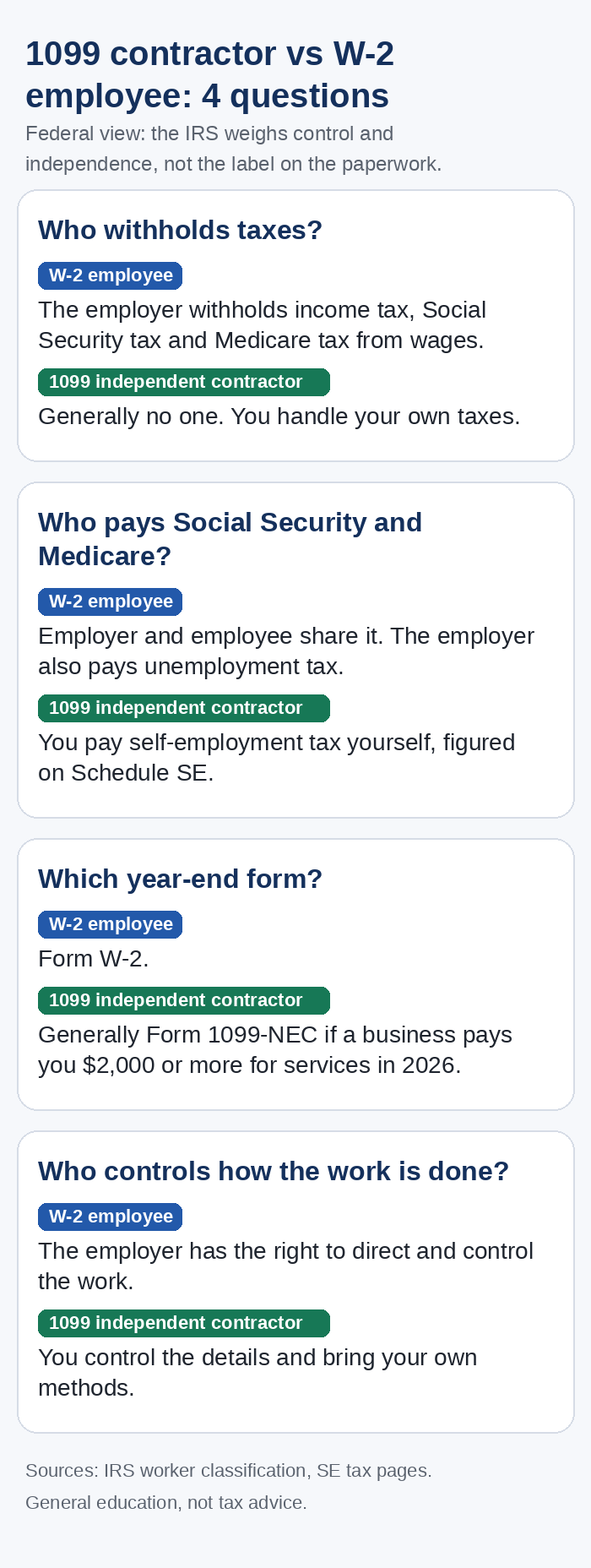
Who withholds taxes?
- W-2 employee: The employer withholds income tax, Social Security tax and Medicare tax from wages.
- 1099 independent contractor: Generally no one. The payer does not withhold or pay these taxes on payments to a contractor.
Who pays the Social Security and Medicare share?
- W-2 employee: The employer pays a matching portion in addition to what is withheld, plus unemployment tax.
- 1099 independent contractor: You pay self-employment tax yourself once net earnings from self-employment reach $400. The standard rate is 15.3% (12.4% Social Security plus 2.9% Medicare), figured on Schedule SE on your net earnings, not your gross payments. For 2026 the Social Security part stops after the first $184,500 of combined wages, tips and net earnings, and an extra 0.9% Medicare tax applies above income thresholds. See the IRS self-employment tax page.
What year-end form do you get?
- W-2 employee: Form W-2.
- 1099 independent contractor: Generally Form 1099-NEC when a business pays you $2,000 or more for services in 2026.
Who sets how the work is done?
- W-2 employee: The employer has the right to direct and control the work.
- 1099 independent contractor: You control the details and bring your own methods.
Sources: IRS, Independent contractor (self-employed) or employee? and IRS, Self-employment tax. For the 1099-NEC threshold and rules, see our guide to issuing Form 1099-NEC.
How the IRS decides: control and independence
For federal employment taxes the IRS uses common-law rules. It weighs the evidence in three groups. No single fact settles it, and there is no set number of factors that makes someone an employee.
- Behavioral control: does the payer have the right to direct what you do and how you do it, through instructions or training? The payer only needs the right to control, not to use it.
- Financial control: who covers unreimbursed business expenses, who invests in the tools and facilities, whether you offer your services to the market, how you are paid, and whether you can make a profit or take a loss.
- Type of relationship: written contracts, employee-type benefits such as insurance, pension or paid leave, how permanent the relationship is, and whether your work is a key part of the company’s regular business.
A written contract that says “independent contractor” counts as one fact, but the IRS says the substance of the relationship governs, not the label. Source: IRS Topic no. 762 and IRS, Employee (common-law employee).
Signs you may be a contractor, and signs you may be an employee
- Points toward contractor: you choose how and when to do the work, use your own equipment, cover your own expenses, have several clients, send invoices, and can earn more or lose money depending on how you run the job.
- Points toward employee: you follow detailed instructions, work set hours at their location or systems, are trained their way, get benefits, work mainly for one company indefinitely, and your work is central to what the company does.
Mixed facts are common. Remote work does not make you a contractor: the IRS says a remote worker is still an employee under the common-law rules if the payer can control what is done and how.
If you are a 1099 contractor: what you handle yourself
- Report your income and expenses on Schedule C and calculate self-employment tax on Schedule SE.
- You can deduct the employer-equivalent half of your self-employment tax when figuring adjusted gross income. This affects income tax only, not the self-employment tax itself.
- No one withholds for you, so plan for quarterly estimated payments. See our guides to quarterly estimated taxes and how much to set aside.
- Expect to give the client a Form W-9 before they pay you. Our W-9 guide walks through it.
- Overtime protections and the new overtime deduction belong to employees. Gig hours do not count toward the overtime deduction, which requires FLSA overtime-eligible employment.
If you think you were wrongly treated as a contractor
Getting a 1099-NEC does not prove you are a contractor. If the facts look like employment, you have these federal options:
- Form SS-8: either you or the business can ask the IRS to make an official determination of your worker status. The IRS says it may take at least six months to receive one.
- Form 8919: a worker who believes an employer improperly treated them as a contractor can use Form 8919 to figure and report the employee’s share of uncollected Social Security and Medicare tax.
- State agencies: unemployment insurance and other state rules may use different tests, and the U.S. Department of Labor notes that a state agency decides whether you are an employee under that state’s law, even if a business calls you a contractor.
Before filing either form, talk with a tax professional about your situation, including the effect on your current client relationship. Sources: IRS, About Form SS-8, IRS, About Form 8919 and U.S. Department of Labor, misclassification.
If you pay workers: you cannot choose the label
A business must decide whether each person is an employee or contractor based on the facts, and the IRS advises documenting the factors used. Treating an employee as a contractor with no reasonable basis can make the business liable for employment taxes for that worker.
- Section 530 can relieve a business of federal employment tax liability for a worker. IRS Publication 1976 lists three requirements, and you must meet all of them: filed required returns (including Forms 1099) consistent with treating the worker as a non-employee; treated the worker and any similar workers as non-employees; and had a reasonable basis, such as a court case, an IRS ruling, a prior audit, industry practice or other reasonable basis. Relief does not make the worker a contractor, and the worker can still be found an employee another way, for example through an SS-8 determination.
- The Voluntary Classification Settlement Program (VCSP, Form 8952) lets an eligible business reclassify workers as employees going forward with partial relief. Eligibility includes having treated the workers consistently as contractors and filed all required Forms 1099 for them for the previous three years, and not being under an IRS employment tax audit or a Department of Labor or state classification audit. The IRS says the business pays 10 percent of the employment tax liability that would have been due on the most recent year’s pay, figured at reduced section 3509(a) rates, with no interest or penalties on that amount.
- If it is still unclear, either side can file Form SS-8.
Sources: the IRS worker classification page, IRS Publication 1976 (Section 530 relief), the IRS VCSP page and IRS Publication 1779. Eligibility rules are detailed; get professional advice before applying.
What to do next
- Write down the three groups of facts for your own situation: control over your work, your costs and risk, and how the relationship runs.
- If most facts point to contractor, set up estimated tax payments and keep records. If most point to employee, raise it with the payer and consider Form SS-8 after professional advice.
- If the answer is unclear or high stakes, use a qualified tax professional or the SS-8 route rather than relying on the contract label.
Editorial note: This guide is general education about federal tax classification, not advice on your facts, your state’s tests or other laws that can use different definitions. See our Financial & Legal Disclaimer.