
A customer tip received through a delivery or rideshare app may qualify for the federal tips deduction. That does not make the whole payout tax-free, and it does not remove self-employment tax. Your occupation, reporting documents, business deductions, household income and filing status all matter.
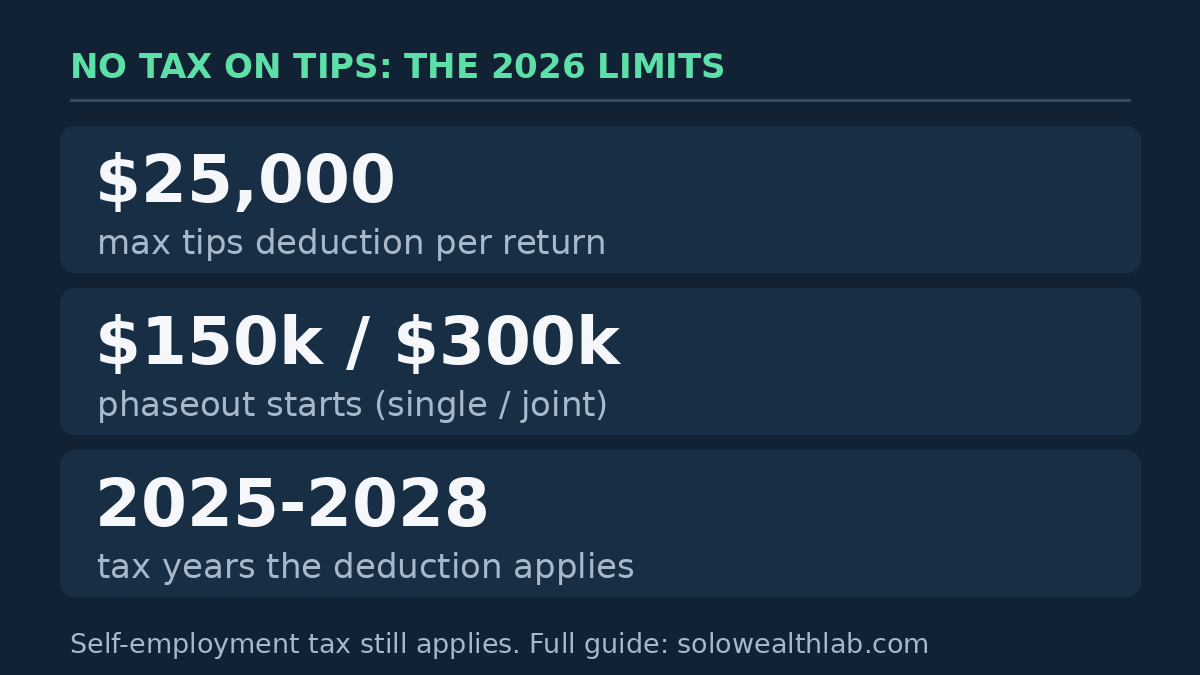
For tax years 2025 through 2028, eligible individuals can deduct up to $25,000 of qualified tips per return. A married couple filing jointly shares that cap; it is not $25,000 for each spouse. The deduction is available with either the standard deduction or itemized deductions. This U.S.-focused guide was reviewed November 7, 2026, and separates the rules for self-employed gig work from employee tip reporting.
What the deduction changes, and what it does not
The deduction reduces federal taxable income, not tax dollar-for-dollar. It is claimed separately from the business-expense calculation on Schedule C. Include your business tip income in gross receipts and figure the business result before working out the separate tips deduction. Do not omit tips from income because you expect to deduct some of them later.
Self-employed tips generally remain part of business income used to figure net earnings subject to self-employment tax. The tips deduction does not remove applicable Social Security and Medicare taxes. State income-tax treatment is a separate question. Keep estimated payments based on your complete federal and state projection, rather than assuming no tax is due on every tip.
For the claiming route and overall limits, see the IRS Schedule 1-A guide. Use our 1099 tax set-aside guide for a broader payment plan; a tips deduction is one input, not a replacement for that calculation.
Check the occupation, not just the app name
A worker must receive tips in an occupation identified as customarily and regularly receiving tips on or before December 31, 2024. That is a test applied to the occupation, not a requirement that you personally had the job before that date. Being a freelancer or receiving a 1099 does not by itself establish eligibility.
The final Treasury regulations include Taxi and Rideshare Drivers and Chauffeurs, code 802, and Goods Delivery People, code 804. They expressly clarify app/platform-based work in these categories. Match what you actually do to the listed description and use the appropriate Treasury Tipped Occupation Code when required.
Other listed occupations can qualify, but do not generalize from a driver example to every consultant, creator or online service. The list, the nature of the payment and the remaining requirements must all be satisfied. Keep records of the work performed, especially if you have several different activities.
Which payments count as qualified tips?
The customer must pay voluntarily, without a consequence for not paying; the amount must be determined by the customer and not be negotiated as the price of the service. Cash and qualifying cash-equivalent payments can include checks, charged tips and cash-denominated app payments. A cashless payment is not automatically disqualified.
A mandatory delivery charge or automatic service charge that the customer cannot disregard or modify is not a qualified tip. A suggested amount that the customer can freely change or decline may be different. Look at the customer’s actual choice, not only the label on the receipt. Platform base pay, a guaranteed service price and a bonus are not converted into customer tips by renaming them.
The final rules also distinguish permitted cash equivalents from noncash property and digital assets, and address abuse and payments for unlawful services. Do not assume every gift or transfer from a customer qualifies. Employee tips received through qualifying tip-sharing arrangements have their own treatment; do not apply employee pooling rules indiscriminately to a self-employed business. The IRS summary of the final regulations explains these boundaries.
A valid SSN and the correct filing status matter
The tip recipient needs a Social Security number valid for employment under the applicable rules. An ITIN is not a substitute for that condition. If married, you must file a joint return to claim the deduction. Check these conditions before treating a projected deduction as available, and use the final instructions for the return year to confirm all requirements.
Self-employed net income is not simply Schedule C profit
For self-employed workers, the deductible tips from a trade or business cannot exceed its gross income minus all deductions allocable to that business, before the tips deduction itself. The calculation is separate for each trade or business. A loss business does not provide a positive limit merely because it received tips.
The IRS Form 1040 instructions, Schedule 1-A section, explain that the limit includes deductions outside Schedule C: the deductible part of self-employment tax, applicable self-employed retirement-plan deductions and the self-employed health-insurance deduction. Those amounts must be allocated where relevant. Do not stop at the Schedule C net-profit line and call that the final limit.
For example, assume you have $4,500 of otherwise qualified tips and the business’s net income after all allocable deductions for this limit is $8,000. The net-income rule would not reduce those tips below $4,500, though the return-wide cap, phaseout and other requirements still apply. If that fully calculated net income is $3,000 instead, only $3,000 from that business can enter the tips-deduction calculation. These are simplified limits, not a complete return calculation.
If you have two businesses or both employee and self-employed tips, keep the amounts and deductions separated. Ask your preparer to show the business-by-business calculation. An owner retirement or health-insurance deduction may reduce the tips limit, so the largest tips deduction alone is not necessarily the best measure of your overall tax result. Review QBI interactions as part of the same return.
Reporting: the self-employed 1099 route is different from Form 4137
The IRS tip recordkeeping and reporting guidance says self-employed individuals generally include tips in Schedule C gross receipts and must meet the applicable information-reporting requirements, such as Form 1099-NEC, 1099-MISC or 1099-K. Keep tip records even where the payer also supplies a statement.
General IRS summaries also mention Form 4137, but that is the direct-report route for employee tips. It is not a blanket substitute for a missing self-employed 1099. The IRS description of Form 4137 says it is used to figure Social Security and Medicare tax on tips not reported to an employer, including applicable allocated tips. Do not move self-employment income into employee reporting to try to create a deduction.
All taxable business income still needs reporting even if no information return arrives. Eligibility for a deduction and the duty to report income are different questions. If a payer’s form is missing or wrong, contact the payer, preserve supporting records and have the claiming route reviewed. Do not invent a form or assume a private spreadsheet replaces a statutory reporting requirement.
Do not carry the 2025 reporting transition into 2026
For 2025, information returns were not required to separately identify qualified tips. IRS transition guidance permits specified methods of identifying the tip portion included in reported totals. Keep app earnings statements, payout histories and other records showing the tips, rather than treating an entire 1099 amount as tips.
The final regulations make clear that the ordinary rule requires qualified tips to be separately reported through the applicable reporting route. The special 2025 transition is not a permanent exemption. For tips earned in 2026, check the payer’s 2026 forms and statements against the final filing instructions; do not reuse a 2025 worksheet or line number without checking it. The IRS 2025 transition guidance is specifically year-limited on reporting.
Income phaseouts and the SSTB rule
The deduction phases out when modified adjusted gross income exceeds $150,000, or $300,000 for joint filers. Use the Schedule 1-A MAGI calculation, not gig revenue or Schedule C profit alone. A spouse’s income or a separate W-2 job can matter. Follow the worksheet for the reduction rather than assuming everyone below the $25,000 tips cap receives the full deduction.
The law also excludes tips received in a specified service trade or business, or SSTB. That issue is separate from whether an occupation is on the tipped-occupation list. However, the IRS has provided transition relief for both employees and self-employed people in otherwise listed occupations. The transition runs until January 1 of the first calendar year following issuance of final regulations on the SSTB determination and associated employer reporting.
The April 2026 occupation-and-tip-definition regulations do not settle that separate SSTB rule. Do not assume their publication alone ended the relief. If your work may be in a specified service field, confirm the guidance applicable to the year being filed rather than claiming permanent eligibility or permanent exclusion. The IRS recordkeeping page describes the transition and its condition.
A practical filing and records checklist
- Record customer tips separately from base pay, bonuses, reimbursements and mandatory charges. Save dates, payer/platform statements and any relevant tip adjustments.
- Match your actual services to a listed occupation. Keep separate records for different businesses and employee jobs.
- Reconcile gross income, information returns, platform fees and bank deposits without counting the same income or expense twice.
- Calculate business net-income limits after all allocable deductions, then apply the shared return cap and MAGI phaseout.
- Use Schedule 1-A and the final instructions for the tax year. Tips earned in 2026 normally belong on the 2026 return filed in 2027, not the 2025 return filed during 2026.
- Keep the supporting calculation with the return and update estimated payments using the complete tax picture, including self-employment and state taxes.
The same law also created a separate deduction for overtime pay, and it follows employee rules rather than gig-work rules. See who qualifies for the overtime deduction before assuming extra hours count.
If you already filed a 2025 return and may have missed an eligible deduction, review whether to amend rather than adding it to a later year. The IRS says some taxpayers affected by the final occupation rules may need an amended return. Confirm eligibility and the original figures before changing the return; an amended return is not a way to skip the reporting or net-income conditions.
Frequently asked questions
Can delivery and rideshare drivers qualify?
Yes, potentially. The final occupation list includes app/platform-based taxi and rideshare work and goods delivery. Customer payments must still be qualified tips, satisfy reporting requirements and pass the personal, business-income and return-wide limits.
Does no tax on tips remove self-employment tax?
No. It is a federal income-tax deduction. Self-employed tips generally remain in business income used to calculate net earnings subject to self-employment tax. State tax treatment also needs separate review.
Can I use Form 4137 for tips from my self-employed gig?
Form 4137 is the direct-report route for employee tips, not a blanket replacement for a missing self-employed 1099. Self-employed workers report business income on the appropriate business schedule and must meet the applicable information-reporting requirements for the tips deduction.
Is Schedule C net profit the final tips-deduction limit?
Not necessarily. The business limit also accounts for allocable deductions outside Schedule C, including the deductible part of self-employment tax, applicable self-employed retirement-plan deductions and self-employed health-insurance deductions. Calculate the limit separately for each business.
Is the deduction $25,000 per spouse?
No. The maximum is $25,000 per return for tax years 2025 through 2028, including a joint return. Business-income limits, the MAGI phaseout and other eligibility requirements can reduce the amount.
Related: how much to set aside for 1099 taxes, quarterly estimated taxes and gig-work expenses that may be deductible.
Editorial note: This is general federal tax education, not a determination of your eligibility or a prepared return. Use the final forms and guidance for the tax year and ask a qualified tax professional about reporting gaps, business allocations and changing transition rules. See our Financial & Legal Disclaimer.