

We have all been there. You land a new client, you are absolutely thrilled about the upcoming project, and you immediately start working based on a quick email agreement or a casual Zoom conversation. The initial energy is high, the budget seems fair, and everyone is excited. Then, the nightmare begins.
The client asks for “just one more quick change” for the fifth time, expanding the project in ways you never initially discussed. They take three weeks to reply to your emails, delaying your entire pipeline. And when you finally send the invoice, they suddenly have “cash flow issues,” request a hefty discount, or worse—they completely ghost you.
Working without a rock-solid contract is the fastest way to burn out in the gig economy. A contract isn’t just a legal document to use in a courtroom; it is a vital boundary-setting tool that tells your client exactly how you do business. It separates the professional business owners from the hobbyists. If you want to survive and thrive as a 1099 professional in 2026, your freelance contract absolutely must include these three non-negotiable clauses.
- Contracts Are Boundaries: A good freelance contract isn’t just about lawsuits; it is about establishing clear expectations for workflow, revisions, and respect for your time.
- Defeat Scope Creep: A Strict Revisions Clause is the only way to prevent clients from demanding endless free updates and changes to your original deliverables.
- Secure Your Income: Without a specific Late Fees and Net Terms clause, clients will treat your invoices as optional suggestions rather than legally binding debts.
- Protect Against Ghosting: A “Kill Fee” ensures you get paid for the work you’ve already completed if a client suddenly cancels the project or disappears mid-way through.
In This Guide
- Why the “Handshake Agreement” is Dead in 2026
- 1. The “Scope Creep” Killer: Strict Revisions Clause
- 2. The “Get Paid” Clause: Late Fees & Net Terms
- 3. The Ghosting Protection: The “Kill Fee” (Termination Clause)
- Bonus: Intellectual Property (Who Owns the Work?)
- How to Present Your Contract Without Scaring Clients Away
- Stop Working on a Handshake
- Frequently Asked Questions (FAQ)
Why the “Handshake Agreement” is Dead in 2026
There was a time when a friendly email confirmation and a deposit were enough to get a freelance project off the ground comfortably. But the freelance landscape has fundamentally changed. As more companies rely on fractional workers and independent contractors to replace full-time roles, the stakes of every project are significantly higher. When budgets tighten, undocumented expenditures are the first things clients attempt to cut or dispute.
When you operate on a handshake basis—or just a simple quote attached to an email—you leave all the gray areas open to interpretation. And in the world of freelance business, interpretation almost always favors the client holding the money.
A comprehensive contract does the heavy lifting of awkward conversations before they even happen. It standardizes your working relationship. When you have a solid contract in place, you don’t have to nervously ask a client why they haven’t paid you; you simply point to Section 4, Clause B of the agreement they already signed. It removes the emotional tension from business disputes.
1. The “Scope Creep” Killer: Strict Revisions Clause
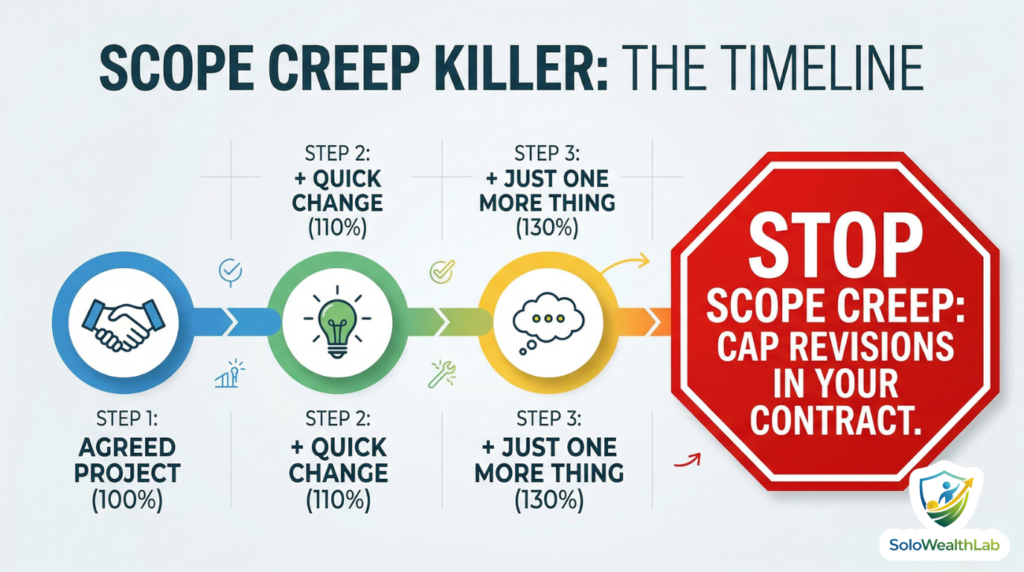
Scope creep is the silent, insidious profit-killer of the freelance world. It rarely happens all at once. Instead, it happens gradually. A client asks to tweak one color, add one extra paragraph, or throw in a quick social media graphic alongside the main project. Because it seems small, you agree. Suddenly, you have done 15 hours of unbilled work and slashed your effective hourly rate in half.
To stop this entirely, your contract needs a highly specific Scope of Work and Revisions clause.
- What it does: It outlines exactly what the client is buying, explicitly stating what is included, what is excluded, and strictly limiting the number of times they can ask for changes without incurring new charges.
- How to write it: “This agreement includes up to two (2) rounds of revisions on the primary deliverable. A ’round of revisions’ is defined as a consolidated list of edits delivered within 3 business days of receiving the draft. Any additional revisions, or requests outside the original Scope of Work outlined in Appendix A, will be billed at an hourly rate of $150/hr.”
By defining exactly what a “revision” is—a consolidated list, not a drip-feed of 40 separate Slack messages over two weeks—you force the client to be organized, decisive, and respectful of your production time. The moment they cross the threshold, the extra hourly billing acts as a powerful deterrent against frivolous changes.
2. The “Get Paid” Clause: Late Fees & Net Terms
Never leave payment deadlines up to the client’s imagination or their accounting department’s convenience. If you just slap “Due Upon Receipt” on the bottom of an invoice without backing it up in your legally binding contract, you implicitly give the client permission to pay you whenever they feel like it.
Many large companies operate on Net-30, Net-60, or even Net-90 terms for their vendors, meaning they purposely hold onto your money for up to three months after you finish the work. As a solo operator, you are not a bank, and you cannot afford to finance your client’s cash flow.
- What it does: It sets a strict legal deadline for your money, formalizes the upfront deposit requirement, and financially penalizes the client for holding onto your past-due payments.
- How to write it: “A non-refundable deposit of 50% is required before any work commences. The Client agrees to pay the final invoice within 15 days of receipt (Net-15 terms). Any invoices not paid within this timeframe will incur a legally enforceable late fee of 5% per month (or the maximum allowed by state law) until the balance is paid in full. The Freelancer reserves the right to halt all ongoing work until past-due invoices are settled.”
Want to look incredibly professional and secure your bag faster? Stop attaching Word document contracts to emails and waiting days for a printed, scanned signature. Use modern software to send a single digital link where the client can sign the contract and pay their upfront deposit via credit card on the exact same page. Check out our guide to the 5 Best Invoicing & Bookkeeping Tools for Freelancers to set this automation up today.
3. The Ghosting Protection: The “Kill Fee” (Termination Clause)
What happens if you are halfway through a massive, month-long project and the client suddenly goes out of business, changes their strategic direction, or completely ghosts you without a trace? If you don’t have a Kill Fee (also known as a Cancellation or Termination clause), you just worked for weeks for free.
Projects get canceled all the time for reasons entirely outside of your control. Your client’s budget might get slashed by their board of directors, or a key stakeholder might leave the company. You cannot absorb the financial shock of their internal corporate chaos.
- What it does: It guarantees you get paid for the time block you reserved and the effort you already invested, even if the project is canceled through no fault of your own. It also outlines exactly how the relationship can be legally terminated by either party.
- How to write it: “Either party may terminate this agreement at any time with 7 days written notice. In the event of cancellation by the Client before project completion, the Freelancer will retain the initial 50% non-refundable deposit. Additionally, the Client will be billed at an hourly rate for all work completed beyond the deposit amount up to the date of cancellation. Final deliverables will not be released until the cancellation invoice is paid.”
This clause ensures that you are never left empty-handed. By stipulating that the initial deposit is explicitly non-refundable to secure your time on the calendar, you protect yourself from clients who “want to test the waters” but flake out a week later.
Bonus Clause: Intellectual Property (Who Owns the Work?)
While the big three clauses cover the immediate financial aspects of your freelance arrangement, there is one more critical element you should strongly consider adding to your standard template: the Intellectual Property (IP) Transfer clause.
A massive point of leverage freelancers have over difficult clients is the copyright to the work produced. Until the client actually pays the final invoice completely, they legally do not own what you created for them. If a client refuses to pay you but starts using your graphics, code, or article on their website, they are committing copyright infringement.
Add this exact language: “The Freelancer retains all copyright and intellectual property rights to the deliverables until the final invoice is paid in full. Upon full payment, the rights are transferred to the Client. Any use of unpaid deliverables by the Client constitutes copyright infringement.”
Nothing motivates a sluggish corporate accounting department to pay a past-due invoice faster than a polite reminder from a freelancer that they do not yet have the legal right to use the multi-thousand-dollar marketing campaign they just launched.
How to Present Your Contract Without Scaring Clients Away
New freelancers are often terrified of looking “too corporate” or scaring away a lead by presenting a heavily worded document. They worry the client will be offended by the suggestion of late fees or strict revisions.
The reality is the exact opposite. Legitimate, high-paying clients expect a contract. If you do not present one, enterprise clients and experienced startup founders will assume you are inexperienced, unprofessional, or running a hobby business.
The trick to presenting a contract without causing friction is entirely in your delivery. Don’t frame it as a legal threat. Frame it as a standard onboarding procedure designed to make the project run smoothly for them.
The perfect email script:
“Hi [Client Name], I am thrilled we are moving forward with this project! Attached is my standard service agreement. It outlines our agreed-upon scope of work, timelines, and exactly what you can expect from me regarding deliverables and communication so we stay perfectly aligned. Please review, sign via the secure link, and take care of the deposit invoice. Let me know if you have any questions, and I will get started right away!”
Stop Working on a Handshake
You do not need an ivy-league law degree or an expensive, $500-an-hour retainer with a business attorney to legally protect your freelance operation. Adding these three simple, clear-cut clauses (Scope Creep/Revisions, Payment Terms/Late Fees, and the Kill Fee) to your standard agreements will instantly weed out bad clients.
Toxic clients who intend to micromanage you, pay you late, or change the scope of work midway through will inherently put up a fight when asked to sign a document holding them accountable. When a client refuses to sign a basic freelance contract, they are doing you a massive favor: they are revealing exactly how they planned to treat you.
Protect your time. Protect your mental health. Protect your bank account. Get it in writing.
Frequently Asked Questions (FAQ)
Can I enforce a contract without hiring a lawyer?
Yes. Most freelance disputes fall under the jurisdiction of Small Claims Court, which is specifically designed for citizens to sue for unpaid debts (usually under $10,000 to $15,000 depending on the state) without needing attorney representation. Having a clearly signed contract is your absolute strongest piece of evidence to effortlessly win a small claims judgment against a non-paying client.
Are email agreements legally binding contracts?
Technically, yes, an exchange of emails where an explicit offer is made and clearly accepted can constitute a legally binding contract. However, email threads are notoriously messy, unorganized, and vast open to interpretation. A formalized, single-document contract clearly outlines all boundaries, including late fees, IP ownership, and termination policies, which a casual email thread almost universally omits.
How high should I make my late fee percentage?
The standard freelance late fee is typically between 1.5% to 5% applied monthly. However, you must be careful and check the usury laws in your specific state or province. Some jurisdictions strictly cap the maximum amount of interest you can legally charge a debtor. A flat fee (e.g., $50 for every week an invoice is late) is another very common and legally simpler method to encourage prompt payment.
Should I write the contract myself or use a template?
While you can write a contract yourself, it is highly recommended to start with a vetted legal template to ensure enforceability. Many online platforms like LegalZoom, specialized freelance CRM tools, and professional creative organizations provide standard templates drafted by actual attorneys. You can then quickly modify the specifics—like your chosen late fee percentage and your preferred revision process—to seamlessly fit your specific business.
What if a client wants me to use their own company contract?
This is extremely common, especially when working with larger enterprise companies or marketing agencies. If a client hands you their standard Independent Contractor Agreement (ICA), read it thoroughly. You can—and should—absolutely request amendments. If their contract states Net-60 payment terms and you strictly operate on Net-15, politely negotiate that change before signing. Professional businesses expect professional pushback on terms that do not suit your established operational model.