

- Part-time / side-hustle driver? → Open a SEP IRA in minutes. Zero paperwork.
- Full-time driver with high net profit? → The Solo 401(k) lets you save far more at the same income level.
- Age 50+? → The Solo 401(k) is the only option with a $7,500 catch-up contribution.
- Want tax-free retirement growth? → Only the Solo 401(k) offers a Roth option.
- Both accounts are based on your net profit, not gross fares — always calculate before contributing.
Driving for Uber, Lyft, or DoorDash gives you ultimate control over your schedule — but it also means you are 100% responsible for your own taxes and retirement. Unlike traditional employees, you receive no corporate 401(k) match, no pension, and no automatic payroll deductions. Every dollar you put toward retirement is a deliberate choice you must make yourself.
The good news? Your 1099 independent contractor status unlocks access to two of the most powerful self-employed retirement accounts available: the Solo 401(k) and the SEP IRA. When comparing a Solo 401k vs SEP IRA for Uber drivers, the right account depends almost entirely on how many hours you drive and how much net profit you actually take home after expenses.
This 2026 breakdown cuts through the jargon. Whether you tap the app for twenty hours a week or drive twelve hours a day, here is exactly which account will save you the most in taxes this year.
The “Net Income” Trap: The #1 Mistake Gig Drivers Make
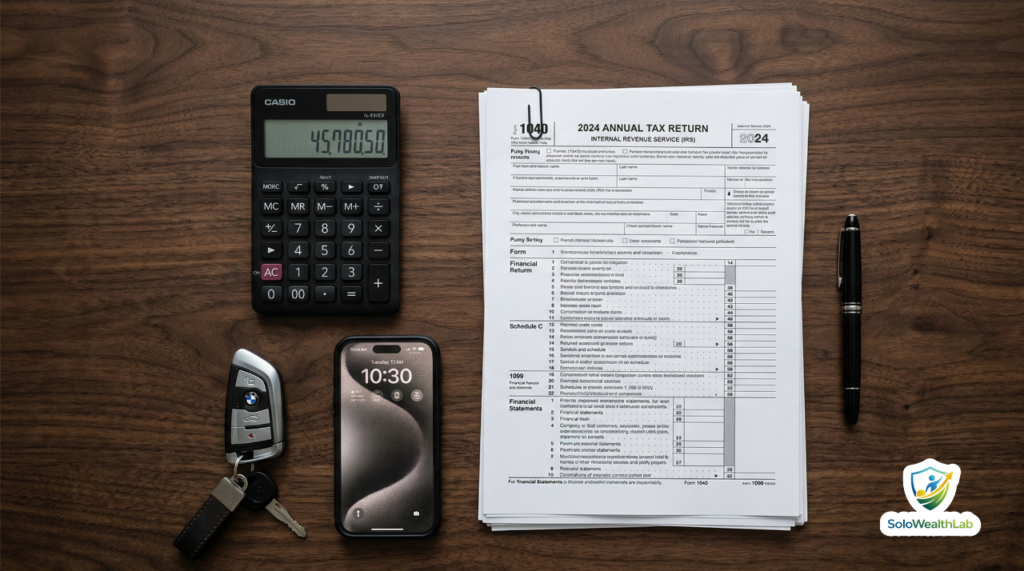
Before you open any retirement account, there is one IRS rule that catches thousands of rideshare and delivery drivers off-guard every single year: your contribution limit is based on your net profit, not the gross income the app reports.
Here is a concrete example. Suppose the Uber app says you grossed $42,000 driving in 2025. Fantastic. But now consider your deductions:
- IRS Standard Mileage Deduction (2026 rate: 70 cents/mile): If you drove 30,000 business miles, that is a $21,000 deduction right off the top.
- Cell phone (business use %), Bluetooth earpiece, phone mount, car washes, tolls, and parking fees could add another $1,200–$2,000.
- Self-Employment Tax Deduction: The IRS lets you deduct half of your 15.3% SE tax as well.
After all these deductions, your Schedule C net profit might sit closer to $17,000–$20,000 — not $42,000. Since both the SEP IRA and the Solo 401(k) calculate contribution limits as a percentage of net profit, this dramatically changes how much you can actually stash away.
The rule of thumb: Always run your estimated Schedule C numbers in a tax software or with a CPA before deciding which account to fund and how much to contribute. Excess contributions carry a costly 6% IRS excise tax penalty per year until corrected.
The SEP IRA: The Perfect Account for Part-Time & Side-Hustle Drivers
The Simplified Employee Pension IRA (SEP IRA) was built with simplicity at its core. For the driver who has a primary W-2 job and uses rideshare or delivery gigs purely for supplemental income, it is hard to beat.
Who Should Open a SEP IRA?
- You drive fewer than 25 hours per week for Uber, Lyft, or DoorDash
- Your net self-employment profit is under $30,000 per year
- You already contribute to a 401(k) through your primary employer
- You value simplicity above all else and hate paperwork
- You procrastinated and need to open an account right now before your tax deadline
SEP IRA Key Details for 2026:
- Contribution Rate: Up to 25% of net self-employment compensation (effectively ~20% of net Schedule C profit after the SE tax deduction adjustment)
- 2026 Annual Maximum: $72,000 (though most part-time drivers will be nowhere near this figure)
- Deadline to Open & Fund: Your tax filing deadline — April 15, 2027, or October 15, 2027 with an extension — for the 2026 tax year
- Administration: Zero annual IRS filing requirements before $250,000 in assets
- Brokers: Available at Fidelity, Charles Schwab, Vanguard, and most major brokerage platforms in under 10 minutes
- Investment Options: Full range of stocks, ETFs, mutual funds, and bond funds
The SEP IRA’s real superpower is its late funding deadline. Unlike a Solo 401(k), which must be established by December 31 of the tax year, you can open and fund a SEP IRA all the way up to your tax filing extension deadline. This makes it the preferred last-minute tax-saving tool for freelancers and gig workers.
The Solo 401(k): The Powerhouse Account for Full-Time Drivers
The Solo 401(k) — also called an Individual 401(k) or a Self-Employed 401(k) — is designed for self-employed individuals with no full-time employees other than a spouse. For the driver who treats rideshare or delivery as their primary business, it is the most powerful tax shelter legally available.
Who Should Open a Solo 401(k)?
- You drive full-time and your net Schedule C profit is $30,000 or higher
- You want to maximize your tax deductions at any given income level
- You are age 50 or older and want to take advantage of catch-up contributions
- You want the option of tax-free Roth growth
- Driving is your only business income (no other self-employed employees)
Solo 401(k) Key Details for 2026:
- Employee Contribution: Up to $24,500 (you, wearing your “employee” hat)
- Employer Contribution: Up to ~20% of net self-employment income (you, wearing your “employer” hat)
- Combined 2026 Maximum: $72,000 (or $79,500 with the age-50+ catch-up)
- Catch-Up Contribution (Age 50+): Additional $7,500
- Roth Option: Available at most brokers — pay taxes now, grow tax-free
- Establishment Deadline: Must be opened by December 31 of the tax year you want to use it
- IRS Form 5500-EZ: Required once account assets exceed $250,000
The key advantage of the Solo 401(k) over the SEP IRA at identical income levels is the employee elective deferral. Consider a driver with $40,000 net profit:
- SEP IRA max contribution: Approximately $7,388
- Solo 401(k) max contribution: Approximately $24,500 (employee) + $7,388 (employer) = $31,888
That is more than four times the tax shelter at the same income level. For a full-time driver in the 22% or 24% federal tax bracket, this difference can mean thousands of dollars less owed to the IRS every April.
Solo 401k vs SEP IRA: Side-by-Side Comparison (2026)
| Feature | SEP IRA | Solo 401(k) |
|---|---|---|
| Best For | Part-time / side-hustle drivers | Full-time drivers, high net profit |
| 2026 Max Contribution | ~20% of net profit (up to $72,000) | $24,500 + ~20% employer (up to $72,000) |
| Catch-Up (Age 50+) | None | Yes — additional $7,500 |
| Roth Option | No | Yes (at select brokers) |
| Admin Complexity | Very Low | Low–Medium (Form 5500-EZ over $250k) |
| Opening Deadline | Tax filing deadline (+ extension) | December 31 of tax year |
| Loan Option | No | Yes (at select brokers) |
| Best Brokers | Fidelity, Vanguard, Schwab | Fidelity, E*TRADE, Rocket Dollar |
The Final Verdict: Which Account is Right for You?
Choose the SEP IRA if: You are a part-time driver or side-hustler, your net driving income is under $30,000, you value simplicity above all else, or you missed the December 31 Solo 401(k) establishment deadline and just want to cut your tax bill before April 15.
Choose the Solo 401(k) if: Driving is your full-time income source, your net Schedule C profit exceeds $30,000, you want aggressive tax savings, you are 50+ and want the catch-up contribution, or you want the Roth option to build a tax-free retirement nest egg.
In most cases, the Solo 401(k) wins on pure numbers for full-time drivers. The math is simply too favorable to ignore — especially in the $30,000–$70,000 net profit range where the employee elective deferral makes a massive difference. But the SEP IRA is a perfectly strong choice when simplicity matters more than maximizing every dollar.
Frequently Asked Questions
Can an Uber driver have both a SEP IRA and a Solo 401(k)?
No. The IRS generally does not allow you to contribute to both a SEP IRA and a Solo 401(k) for the same business income in the same tax year. You must choose one. However, if you have multiple separate self-employed businesses, the rules become more complex and a CPA should advise you.
Do mileage deductions lower how much I can contribute to retirement?
Yes. Business deductions like the IRS standard mileage rate reduce your net Schedule C profit. Because both the Solo 401(k) and the SEP IRA calculate contributions as a fixed percentage of net profit, larger mileage deductions directly reduce your maximum allowable retirement contribution. This is not a reason to skip deductions — just something to calculate carefully each year with your CPA.
Does having a W-2 job affect my Solo 401(k) as an Uber driver?
Yes, partially. The $24,500 employee elective deferral limit for 2026 applies across ALL 401(k) plans combined — meaning if you defer $15,000 at your day job’s 401(k), you can only defer an additional $9,500 as the “employee” in your Solo 401(k). However, the employer profit-sharing contribution based on your rideshare net profit is not affected and can be made in full.
What is the best broker for a Solo 401(k) for gig workers?
Fidelity and E*TRADE are the top commission-free options for a traditional pre-tax Solo 401(k). If you want a Roth Solo 401(k) with more flexibility, Rocket Dollar and Alto IRA offer strong self-directed options. Always compare plan documents before opening an account to confirm they allow the contribution type — pre-tax, Roth, or both — that matches your tax strategy.
Disclaimer: Solo Wealth Lab does not provide individual tax advice. The figures in this article are based on IRS guidelines for the 2026 tax year and are subject to change. Always consult a licensed CPA or tax professional before making retirement contribution decisions, particularly if you use the IRS standard mileage deduction as your primary business expense strategy.